Matt: Important Security Update

WordPress 7.0.2 went out today with two important security updates. One is a type of pre-authorization RCE we (fortunately!) have only seen a few times in WordPress’ 23-year history; the last, I believe, in the PHPMailer class five years ago.

Major kudos to Adam Kues of Searchlight Cyber for finding the batch REST API RCE, to TF1T, dtro, and haongo on the facilitated SQL injection!

Thanks to responsible disclosure, the WordPress.org Security team was able to coordinate with hosts and CDNs to mitigate the attack at the network layer. Please upgrade anyway! But it’s a huge relief to know the vast majority of WordPress sites were protected by defense-in-depth even before the updates went out.

I really appreciate how people and organizations that otherwise might not be on the best of terms come together in times like this. (Full credits in the release post.) Everyone buries the hatchet to protect as many people as possible as quickly as possible.

I’ve said it before, I’ll say it again: security is going to be a big topic this year as the technology industry digests the incredible advances in AI models. It’s a good time to review your plans and processes, sweat the details, invest in maintenance, and hug a sysadmin. 🙂


WordCamp Central: WordCamp Rajshahi 2026: Celebrating Community, Learning, and Open Source

WordCamp Rajshahi 2026, held on July 2nd-3rd, 2026, at the Rajshahi University of Engineering & Technology (RUET) Auditorium, brought together WordPress enthusiasts, developers, designers, business owners, students, and open-source contributors from across Bangladesh and beyond. As a non-profit, community-driven conference, the event demonstrated the strength of collaboration, knowledge sharing, and the spirit of open source.

More than just a technology conference, WordCamp Rajshahi became a place where people connected, exchanged ideas, and inspired one another to contribute to the future of WordPress.

Sharing Knowledge That Matters

The conference featured a diverse lineup of local and international speakers who shared practical experiences, real-world case studies, and emerging trends shaping the web today.

Artificial intelligence was one of the most discussed topics throughout the event. Sessions explored how AI is transforming the way developers and businesses work—from integrating AI into WordPress without writing code to building customer support agents, using modern Large Language Models (LLMs) for development, debugging applications, and improving everyday workflows.

Performance, architecture, and security also received significant attention. Speakers demonstrated advanced WordPress optimization techniques, object caching strategies, no-code animations using GSAP, methods for identifying system vulnerabilities, and practical approaches to cleaning malware-infected WordPress websites with AI.

Beyond technical sessions, the conference emphasized personal and professional growth. Attendees learned about building successful careers, transitioning from startups to multinational companies, product marketing, the realities of remote work, and maintaining mental well-being while working in the technology industry.

Contributor Day: Giving Back to WordPress

Contributor Day, held on July 2, served as one of the most meaningful parts of the event.

Participants worked alongside experienced WordPress contributors and Table Leads to improve the WordPress project itself. Whether they contributed to Core, Accessibility, Themes, Plugins, Polyglots (translations), Education, or Photos, attendees experienced firsthand how community collaboration built the global WordPress ecosystem.

For many first-time contributors, it was their first opportunity to make a direct contribution to one of the world’s largest open-source projects.

Campus Connect: Inspiring the Next Generation

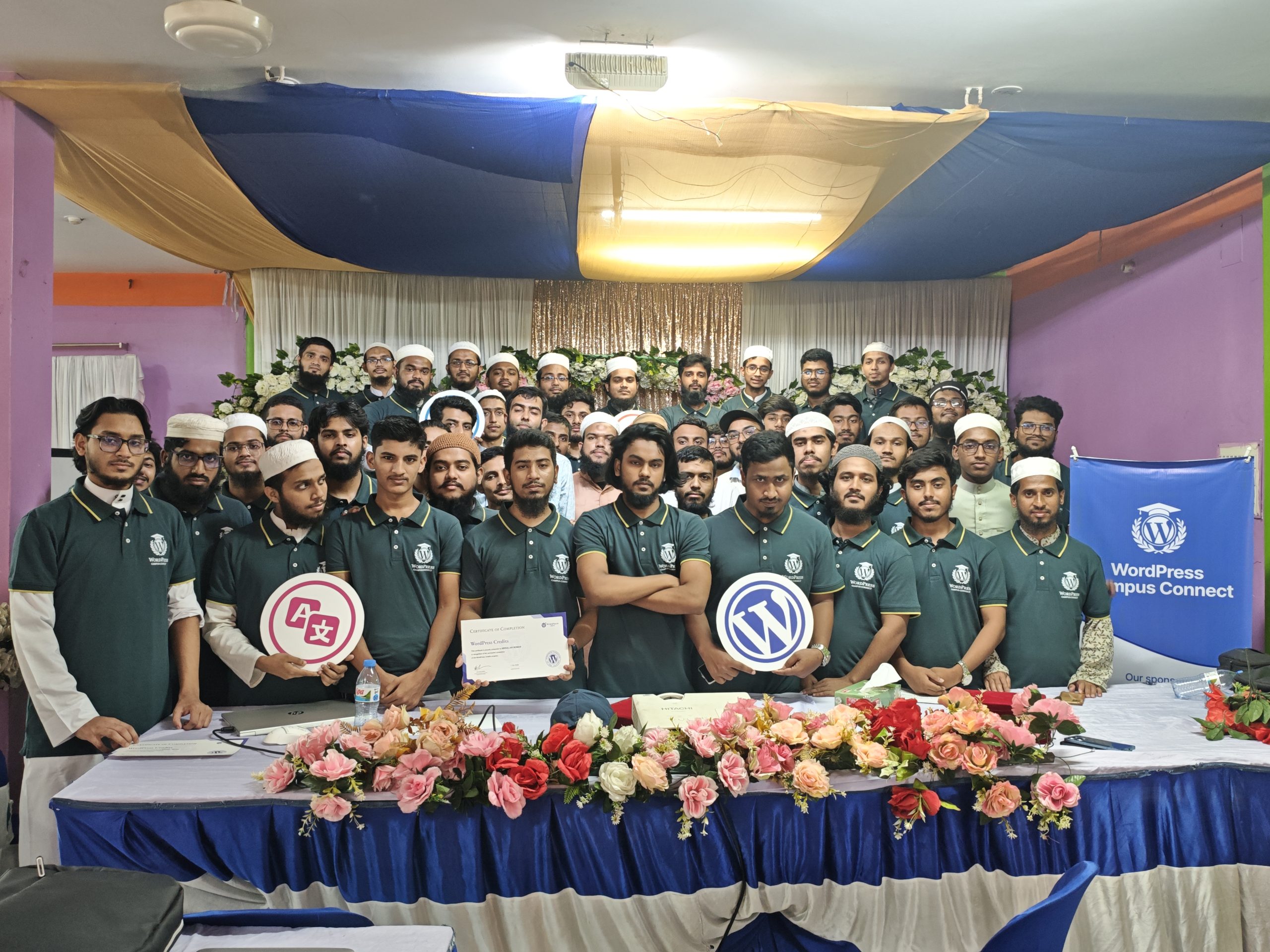
One of the highlights of WordCamp Rajshahi 2026 was the Campus Connect initiative.

To encourage student participation in open source, 40 university students received complimentary tickets to attend the event. This initiative introduced young learners to the WordPress community, allowing them to interact with experienced professionals, attend technical sessions, and discover opportunities to contribute to open source.

By investing in students today, the community hopes to cultivate the next generation of developers, designers, and contributors who will help shape the future of WordPress.

Sponsors Who Made It Possible

WordCamp events are made possible through the generous support of organizations that believe in strengthening the open-source ecosystem. Rather than simply sponsoring an event, these companies invest in community growth and knowledge sharing.

This year, the sponsorship tiers celebrated Rajshahi’s famous mango heritage.

Fazli Majesty (Platinum Sponsors)

Himsagar Legacy (Gold Sponsor)

Amrapali Delight (Silver Sponsors)

Community Sponsors

Official Partners

  • FM Networks (Internet Partner)
  • TNR Soft (Payment Gateway Partner)

Their support enabled the community to deliver a world-class experience while keeping the event affordable and accessible.

Thank You to Everyone Behind the Scenes

An event of this scale is never the work of a single person.

Our sincere appreciation goes to every speaker and Contributor Day table lead who generously shared their knowledge and experience with the community.

We are equally grateful to our organizers and volunteers. From sponsorship coordination, website management, registration, design, photography, audiovisual production, venue operations, food management, and attendee support, every team member played a vital role in ensuring the event ran smoothly.

Their dedication transformed months of planning into an unforgettable experience for every attendee.

Looking Ahead

WordCamp Rajshahi 2026 demonstrated what is possible when passionate volunteers, contributors, sponsors, and community members work toward a common goal.

The event was more than a conference—it was a celebration of learning, collaboration, and the open-source values that make WordPress one of the world’s most successful communities.

As the community continues to grow, the relationships built, ideas shared, and contributions made during WordCamp Rajshahi 2026 will inspire future events and encourage even more people to participate in the global WordPress ecosystem.

Here’s to many more WordCamps, more contributors, and a stronger open-source community in Bangladesh and beyond.


Gutenberg Times: #WCUS Schedule, iframed Post Editor, WooCommerce 11.0 and so much more — Weekend Edition 369

Hi there!

What a week! WordPress 7.1 Beta 1 (and Beta 2) arrived with a huge array of updates. We’ll unpack them together over the next four weeks, right up to the final release on August 19, 2026.

One thing shouldn’t wait, though: the security release WordPress 7.0.2. Go update your production sites now — this newsletter will still be here when you’re back. 😉

In this edition, you’ll also find the first speaker lineup for WordCamp US, a fourth page-builder migration story, WooCommerce 11.0 on the horizon, and plenty of block development goodness: from iframed editors to on-brand maintenance pages.

Grab your favorite Saturday beverage and dig in.

Yours, 💕
Birgit


WordCamp US 2026: Four Tracks, Three Workshops, 33 Speakers

First speaker spotlight WordCamp US>

The first wave of WCUS 2026 speakers is live — and it reads like a who’s-who of WordPress in practice.

WordCamp US just published its opening lineup for August 16–19 in Phoenix: 34 confirmed speakers so far, including K Adam White, Brian Coords, Jamie Marsland, Kathy Zant, Miriam Schwab, and Robert Abela, all experienced developers, educators, security specialists, community builders.

The program runs four tracks.

  • AI in Action leads with sessions on agentic workflows, AI search, and guardrails for AI-assisted development.
  • Honing Your Skills covers the practical side: maintenance, privacy compliance, creator commerce, security.
  • Technical WordPress digs into block migrations at scale, WP-CLI automation, and plugin pipelines.
  • Beginning WP101 is the on-ramp for newcomers — or for clients you’re bringing along.
  • Three hands-on workshops round out the program, where you build something real in the room and leave with it.

The full session schedule isn’t out yet, but the speaker list alone is a useful signal. If someone on that page is a voice you follow, a tool you depend on, or a corner of WordPress you’re actively navigating, you now have a specific reason to be in the room.

🎟 us.wordcamp.org/2026/tickets — $100 General Admission · $750 Micro-Sponsor (includes listing on the sponsors page) 👥 Full speaker list →

Developing Gutenberg and WordPress

WordPress 7.1 Beta 1 was release on July 15, 2026. is now available for testing. The release post offers instructions how to sent up a test side and shows an extensive list of new features.

The security team released WordPress 7.0.2 with the urgent appeal to update right away. The security fixes were also backported in 6.9.5 and 6.8.6.

The security fix was also included in WordPress 7.1 Beta 2, so testing sites are also protected during this release cycle.

Huzaifa Al Mesbah, from the Core Test team, published the accompanying Help Test WordPress 7.1 post.

A few WordPress 7.1 Dev Notes are already available:

Plugins, Themes, and Tools for #nocode site builders and owners

In about 10 days, WooCommerce 11.0 release is schedule. Brain Coords has the skinny for you in what’s coming for developers in WooCommerce. Performance leads the release with 28 PRs — product object caching becomes the default for new stores, speeding up variable products by 9–12%. You’ll also find email verification connecting guest orders to accounts, new phone validation hooks, video embeds in the block email editor, and the final removal of the Product Editor beta. The beta is ready for your testing now.


Jamie Marsland followed his instincts and build Jamie’s Front-End Editor for Content Teams, a plugin that lets your editors click any paragraph or heading on the live page and start typing — no block editor required. With the latest updates, you can now edit text, links, buttons and images right on the live page. No wp-admin, no block editor, just click and change it in place.

Built on the Interactivity API with no build step, it preserves block markup on save, records edits as native block notes for an audit trail, and lets you restrict chosen roles to front-end-only editing. Let Marsland what you think.


Last week, I shared three migration stories from page builders to the Core block editor and block themes. Here’s a fourth perspective: The team at WP Expert, an Ottawa agency founded by Frederic Sune, put together a comprehensive post on migrating agency sites from page builders to Gutenberg, should you go on that journey, too. You’ll find the strategic arguments (better Core Web Vitals, smaller attack surface, less technical debt) alongside a practical playbook covering backups, staging, block theme selection, pattern development, and SEO safeguards. The post also explores what block-based architectures mean for an agency’s business model, from premium modernization packages to fewer layout-related support tickets. An FAQ rounds it out.

Theme Development for Full Site Editing and Blocks

Brian Coords tackles a common WooCommerce pain point: custom product templates for block themes. He combines two core WordPress features — the plugin template registration API from 6.7 and the venerable single_template_hierarchy filter — to serve custom templates for product collections, like all products in a category. His example plugin falls back to your Single Product template unless you override it. Clone the repo and give it a try; custom Product fields are next on his list.


On the WordPress Developer Blog, Troy Chaplin shows you how to build an on-brand maintenance mode for block themes. You add one small hook to your theme’s functions.php once, then design and manage the maintenance page entirely in the Site Editor with full access to your Global Styles. Renaming or deleting the template toggles maintenance mode on and off, no code needed. An SEO-friendly variant adds 503 headers so crawlers know the downtime is temporary.

“Keeping up with Gutenberg – Index 2026”
A chronological list of the WordPress Make Blog posts from various teams involved in Gutenberg development: Design, Theme Review Team, Core Editor, Core JS, Core CSS, Test, and Meta team from Jan. 2024 on. Updated by yours truly. 

The previous years are also available:
2020 | 2021 | 2022 | 2023 | 2024 | 2025

Building Blocks and Tools

On WP Mayor, Jean Galea untangles when to reach for WP-CLI, the REST API, or the Abilities API. His mental model: they’re layers, not rivals. WP-CLI lives on the server for bulk work, REST serves off-server callers like headless front ends, and the Abilities API tells AI agents what they’re allowed to do, complete with schemas and permission checks. Galea also shares how his own sites lean on all three at once.


Get up to speed how to make your custom blocks plugin work in the iframed post editor, if you haven’t yet. After five years of ruminating and communicating the switch is coming to WordPress 7.1. In his post, Ryan Welcher explains why the post editor is going full iframe in WordPress 7.1 and what that means for your custom blocks. You’ll find the fixes for the most common breakage — global window and document references, editor styles enqueued into the wrong document, stale admin-scoped CSS, and third-party libraries — plus a companion demo plugin with broken/fixed block pairs, Playground blueprints for testing both states, and a handy pre-flight checklist.


The video volunteers at WordCamp Portugal uploaded all recordings to WordPressTV and two of the talks caught my eye:

Imran Sayed walks you through the fastest way to build Gutenberg blocks with modern tools, scripts, and AI. If custom block development has felt complex or time-consuming, you’ll appreciate his focus on practical, real-world workflows you can adopt immediately — moving fast without over-engineering. The recording is available on WordPress.tv, and the presentation slides are linked below the video for easy reference.

Jorge Costa shows you how to use the AI building blocks already shipped in WordPress core (the WP AI Client, the Abilities API, and the MCP adapter) to bring AI-powered features into your own plugins, themes, and sites. He also tackles the bigger question: when agents can spin up entire projects on any stack, why is WordPress still the right bet? Slides are linked alongside the recording.


Check out the not so new any more Talk Devy to Me series on Ryan Welchers YouTube Channel! In the latest epsiode, Antonio Sejas demos Studio Code, the agentic AI assistant built into WordPress Studio’s desktop app and CLI. You can spin up sites, run performance audits, add content, and install plugins and themes through natural language conversation — all locally, so nothing you break goes public. Sejas explains how it works under the hood before building something live with the host. Studio Code is free while in beta, so now’s a good time to experiment.


If you rather want to read about the updates in WordPress Studio, Fredrik Rombach Ekelund shares three big updates to WordPress Studio: a new default Native PHP runtime makes your local sites load 30–50% faster while using a third of the memory, the Studio CLI now installs with one dependency-free command — no Node.js or npm required — and Claude Sonnet 5 is the new default model in Studio Code, improving multi-step work like tracing bugs across files. A Sandbox runtime remains available for testing untrusted code.


Need a plugin .zip from Gutenberg’s master branch?
Gutenberg Times provides daily build for testing and review.

Now also available via WordPress Playground. There is no need for a test site locally or on a server. Have you been using it? Email me with your experience.


Questions? Suggestions? Ideas?
Don’t hesitate to send them via email or
send me a message on WordPress Slack or Twitter @bph.


For questions to be answered on the Gutenberg Changelog,
send them to changelog@gutenbergtimes.com


Featured Image:


Open Channels FM: Open Source and the Open Source Initiative

People think Open Source is just about having access to the source code. Actually, there’s a much longer history behind it. Open Source existed before the term Open Source was even coined, back in the late 60s. Universities started giving away software like Unix for free under small licenses like BSD or MIT, coincidentally named […] 

Ultimate WordPress Spam Protection Guide – Step by Step (2026)

If you run a WordPress site, then you know that spam is a real annoying problem whether it comes to contact forms, WordPress comments, or user registrations.

The good news is that stopping spam in WordPress is a lot easier than you probably think, and you don’t need expensive tools either.

We have spent over 16 years testing anti-spam plugins, tools, and refining strategies to keep WPBeginner and our other business websites safe from daily spam attacks.

In this ultimate guide, we’ll walk you through how to block each type of WordPress spam, step by step from the basics to advanced modern automated spam protection. These are the exact methods we’re using to protect our own websites.

The Ultimate WordPress Spam Protection Guide - Step by Step

We’re covering a lot of ground in this ultimate guide, so use the quick links below to jump straight to the section you want to learn about first:

1. Free Built-In Settings to Turn On First

WordPress comes with several anti-spam options that can protect your site against spam. These built-in options won’t stop every bot, but they will remove the easiest targets right away.

We always recommend turning these settings on first, because they cost nothing and take only a few minutes to set up.

Tighten Your WordPress Discussion Settings

To prevent comment spam, the built-in discussion settings in WordPress act as your first line of defense. They allow you to control who can post, what kind of links are permitted, and how much control you have over the conversation.

To configure these anti-spam controls, go to Settings » Discussion in your WordPress dashboard.

Protecting the WordPress comment section against spammers

The most useful tool on this screen is the comment moderation queue. This tool acts as a holding area that keeps submissions hidden from the public until you have a chance to look them over.

Because nothing goes live automatically, spam never reaches your visitors, even if it manages to get past your other filters.

To turn this on, scroll down to the ‘Before a comment appears’ section and check the box next to ‘Comment must be manually approved.’

How to require manual approval for WordPress comments

If you want, you can also enable ‘Comment author must have a previously approved comment.’ This lets returning commenters post without waiting for approval. However, be sure to review your published comments regularly since they won’t appear in your moderation queue.

After that, scroll to the ‘Comment Moderation’ box, where you’ll find a setting that limits links. Because spam comments almost always contain web addresses, WordPress can automatically hold any submission that includes too many links.

The field labeled ‘Hold a comment in the queue if it contains [X] or more links’ is set to 2 by default. Lowering that number to 1 will help you catch even more junk.

Adding comments to an approval queue in WordPress

On the same screen, you can use the comment blocklist to automatically filter out unwanted content. This tool looks for specific words, names, email addresses, or web addresses and sends any matching comment straight to the trash.

In the ‘Disallowed Comment Keys’ box, you can paste your own trigger words, putting one on each line, and then save your changes.

Filtering your WordPress comments
Require a Name and Email, and Hold First-Time Commenters

Healthy discussions start with real people. Requiring commenters to enter a name and email encourages more thoughtful conversations and discourages anonymous drive-by comments.

Most genuine visitors won’t mind providing these details, and it helps create a more welcoming and trustworthy community around your website.

To enable this, scroll to the ‘Other comment settings’ section and check the box next to ‘Comment author must fill out name and email.’

How to block anonymous comments on your WordPress website

If you want to master the review process and manage your queue efficiently, our beginner’s guide to moderating comments in WordPress covers the full workflow.

Disable Comments Where You Do Not Need Them

Depending on the type of website you have, you may not need a comment section at all. If that’s the case, then you can simply disable comments entirely and that’ll get rid of the WordPress comment spam problem once and for all.

The most thorough option is the code method, which disables comment support across your entire site at once. It’s safest to add the snippet with a free code snippets plugin like WPCode rather than editing your theme’s files directly, so a theme update can’t undo it.

add_action('admin_init', function () {
    // Redirect any user trying to access comments page
    global $pagenow;
    
    if ($pagenow === 'edit-comments.php') {
        wp_safe_redirect(admin_url());
        exit;
    }

    // Remove comments metabox from dashboard
    remove_meta_box('dashboard_recent_comments', 'dashboard', 'normal');

    // Disable support for comments and trackbacks in post types
    foreach (get_post_types() as $post_type) {
        if (post_type_supports($post_type, 'comments')) {
            remove_post_type_support($post_type, 'comments');
            remove_post_type_support($post_type, 'trackbacks');
        }
    }
});

// Close comments on the front-end
add_filter('comments_open', '__return_false', 20, 2);
add_filter('pings_open', '__return_false', 20, 2);

// Hide existing comments
add_filter('comments_array', '__return_empty_array', 10, 2);

// Remove comments page in menu
add_action('admin_menu', function () {
    remove_menu_page('edit-comments.php');
});

// Remove comments links from admin bar
add_action('init', function () {
    if (is_admin_bar_showing()) {
        remove_action('admin_bar_menu', 'wp_admin_bar_comments_menu', 60);
    }
});

Our guide on how to completely disable comments in WordPress walks through that snippet along with the other options.

If you’d rather not go site-wide, you can also turn comments off on individual pages. This is handy when you only want them gone on specific pages, like your Contact or About pages, which rarely need a comment section.

To do this, open the page in the WordPress content editor. Then click the ‘Discussion’ option in the right-hand sidebar and select ‘Closed.’

How to disable comments on your WordPress pages

You can also stop spam from piling up on older content without touching your newer posts. If you don’t expect comments on old posts, then WordPress can close them automatically after a set number of days.

This gives spam bots fewer chances to target your archived content.

To set this up, head to Settings » Discussion and find the ‘Other comment settings’ section. Check the box next to ‘Automatically close comments on posts older than [X] days’, then set a sensible limit such as 30 or 90 days.

Automatically closing comments on older WordPress posts
Disable Trackbacks and Pingbacks

Trackbacks and pingbacks notify you when another website claims to have linked to one of your blog posts.

While they were originally designed to help bloggers connect conversations across different websites, they’re now commonly abused by spammers to send fake link notifications.

Turning this feature off completely removes a whole category of junk notifications from your dashboard.

To disable these notifications, go to the Settings » Discussion screen in your WordPress dashboard. Here, uncheck the box next to ‘Allow link notifications from other blogs (pingbacks and trackbacks) on new posts.’

Disabling pingbacks and trackbacks in WordPress Discussion settings
With that done, don’t forget to click ‘Save Changes’ at the bottom of the screen.

Just be aware that changing this option only protects the posts you publish from this moment forward. If you want to clean up the content you’ve already published in the past, you can follow our step-by-step guide on how to disable trackbacks and pings on existing WordPress posts.

2. Set Up Modern AI-Powered Spam Bot Protection for WordPress

In the era of AI where automated spam is increasing, the best defense against it is a modern AI-powered spam protection for WordPress.

These spam filtering solutions automatically detect and block spam on your WordPress comments, contact forms, and user registrations without the use of CAPTCHA which can hurt conversions.

On WPBeginner, we use ActiveLayer for this. It is AI-powered and runs server-side, so it stops spam invisibly, without a CAPTCHA and it’s GDPR compliant.

In the last 30 days, it has blocked over 25,739 spam comments and contact form submissions on our website. It even shows you a confidence score, and the reason behind every submission it flags, not just a pass-or-fail verdict when you look at their logs.

ActiveLayer Spam Stats Screenshot for WPBeginner

The free plan includes 1,000 spam checks with no credit card, and paid plans start at around $4 per month billed yearly.

The two other popular spam filtering plugins for WordPress you could try are Akismet or CleanTalk.

Akismet is very popular and still is a good fit for personal blogs, where its “name your price” plan can be free for non-commercial sites. But they have raised their prices significantly for commercial sites which is quite expensive for smaller businesses. For a business site, we would point you to either ActiveLayer or CleanTalk.

Whichever tool you choose, stick to just one, because running two spam filters at once can conflict and block real visitors. The benefit of these spam protection plugins are that they integrate with all other popular contact form plugins by default.

3. Power-User Tips for Stopping WordPress Comment Spam

So far we’ve configured the built-in spam prevention settings in WordPress, and an automated spam filtering plugin for WordPress. The combination of these two should block most spam.

However if you are not able to set up modern AI spam protection due to costs or another reason, then you can use one of these tips below to combat comment spam in WordPress.

Add a Free CAPTCHA to Your Comment Form

CAPTCHA is a simple test that most human visitors pass without any effort, while automated scripts fail it. We recommend adding Cloudflare Turnstile CAPTCHA to your WordPress comments because it’s free and fairly straight forward to set up.

To set it up, install and activate the free Simple Cloudflare Turnstile plugin. You will be asked to create a free account on Cloudflare’s website and connect it with the plugin.

Once that’s done, you can scroll to the ‘Enable Turnstile on your forms’ section. Simply check the boxes to protect all your WordPress forms and click ‘Save Changes’.

How to protect your site against spammers and spambots using the free Simple Cloudflare Turnstile plugin

Here’s our detailed guide on how to add Cloudflare Turnstile CAPTCHA in WordPress.

Google reCAPTCHA is another option, which you can add with the Advanced Google reCAPTCHA plugin. We no longer recommend it because Google has capped their free tier at 10,000 assessments per month for your entire organization whereas Cloudflare Turnstile stay free without limits.

Limit or Require Login to Comment

Another really effective way to stop comment spam in WordPress is to control who’s allowed to participate in comments.

If your comment section is open to everyone, then spammers can continuously flood your forms with automated links. Restricting comments to registered account holders ensures that only verified users can post. This forces a level of accountability that most bots will not bother trying to bypass.

Because it requires readers to go through the extra step of creating and logging into an account, this approach is best suited for membership sites, online forums, and private communities.

If you run an open, public blog, then we’d recommend using an automated filtering service or a reader challenge instead as those add less friction.

If you do decide to turn this restriction on, go to Settings » Discussion in your WordPress dashboard. Under the ‘Other comment settings’ section, check the box next to ‘Users must be registered and logged in to comment.’

Requiring user registration before allowing comments

As always, don’t forget to save your changes.

Use Antispam Bee for Free Keyword and Pattern Filtering

Some spam slips through basic checks by mimicking human writing. This is where a dedicated filtering plugin can help protect your site.

Antispam Bee is an excellent free, privacy-friendly anti-spam plugin that doesn’t require an API key or account registration. Installing Antispam Bee gives you a powerful set of local rules to analyze comment data before it even hits your database.

Once it’s activated, you can configure your rules by going to Settings » Antispam Bee.

Protecting your site against automated spam scripts using WordPress plugins

We recommend enabling the options to:

  • Trust approved commenters.
  • Mark as spam.
  • Do not delete.
  • Use regular expressions (which allows the plugin to scan for known text and link patterns).

You should also check the box to ‘Look in the local spam database.’ This allows Antispam Bee to cross-reference new submissions against previous spam history on your site.

Look in your local spam database

Under ‘Advanced,’ you can set Antispam Bee to delete existing spam after a set number of days, which keeps your database tidy without any manual effort.

We highly recommend leaving the email notifications for spam turned off in this section. A busy website can attract hundreds of automated submissions a day, and these alerts will quickly flood your inbox.

If you want to try one more free tweak, then you can remove the website address field from the comment form.

Our step-by-step guide on how to remove the website URL field from the comment form shows you how to do this in just a few quick steps.

4. Stopping WordPress Contact Form Spam (Best Practices)

Contact and lead forms are among the most attacked parts of any WordPress site. We know this firsthand because we once had to combat more than 18,000 spam entries flooding a single form.

We use WPForms to build forms on WPBeginner, and it’s a popular form builder plugin used by over 5 million websites. Their free version includes smart anti-spam protection, CAPTCHA integrations with Google / Cloudflare Turnstile, and the paid plans add the filtering options we cover below.

Other popular form builders like Gravity Forms and Fluent Forms have similar anti-spam settings, so check the options in whichever form builder plugin you use. We will show WPForms here because it’s what we use and consider the best fit for beginners.

Enable Default Anti-Spam Token (or Similar HoneyPot)

To combat lead form spam, WPForms silently attaches a unique, time-sensitive token to your form on every page load. The anti-spam token blocks automated scripts, which means spam entries are blocked before they reach your inbox.

It’s turned on by default for new forms, but it’s worth confirming.

Open your form, go to Settings » Spam Protection and Security, and make sure ‘Enable modern anti-spam protection’ is switched on.

An example of a form builder with built-in anti-spam protection

This is a modern version of the Honeypot technology which most WordPress form plugins come with, so it may be labeled as Honeypot in another form tool that you might be using.

Enable a CAPTCHA on Your Contact Form

More aggressive bots mimic human browsing and slip past the invisible token. Adding a visible CAPTCHA field stops them by forcing a challenge they can’t read or solve.

WPForms has both Cloudflare Turnstile and Google reCAPTCHA built in, and we default to Turnstile here. It’s free for everyone and runs its checks in the background, so most real visitors pass without solving a puzzle.

To set it up, go to WPForms » Settings » CAPTCHA and choose ‘Cloudflare Turnstile’.

Adding Cloudflare Turnstile CAPTCHA to a WordPress website

Then add the Site Key and Secret Key from your Cloudflare account, and save your settings.

Finally, add the CAPTCHA field to each form you want to protect.

Add Turnstile field to WPForms

For a full walkthrough, see our guide on how to add Cloudflare Turnstile CAPTCHA in WordPress.

Google reCAPTCHA is also selectable on that same WPForms » Settings » CAPTCHA screen. We default to Turnstile because it’s free without limits, but reCAPTCHA still works if you prefer it.

If you’d rather not send visitor data to Google or Cloudflare, then WPForms’ Custom Captcha field (available on any paid plan) builds the challenge on your own server instead.

Add the field, then set it to a random math problem or your own question and answer.

Setting a question and answer custom CAPTCHA in WPForms
Use Time-Based Behavioral Checks to Stop Contact Form Spam

A real person needs several seconds to read a question and fill out a form, while a bot submits in a fraction of a second. Time-based checks flag those impossibly fast submissions without changing anything the visitor sees.

With WPForms, the ‘Enable minimum time to submit’ option is enabled by default with a minimum time to submit of 2 seconds. However, you can update the minimum time to any value you like.

The WPForms minimum time to submit anti-spam setting
Block Form Submission by Country, IP, Email Address, and More

Some spam form submissions still gets through unless you screen the content itself. In the Pro version, WPForms lets you block entries by specific email address, by keyword, and by country or IP address.

To block a sender, open your form, select the Email field, open the Advanced tab, choose Denylist, and enter the addresses or domains to ban. A wildcard like *@example.com blocks an entire domain.

Advanced email allowlist and denylist filtering in WPForms

To block spammy phrases, go to Settings » Spam Protection and Security.

Turn on ‘Enable keyword filter’, open ‘Edit keyword list’, and add each term on its own line.

Creating a list of banned words for your online forms

And if you only serve certain regions, turn on ‘Enable country filter’ on the same screen to allow or deny locations.

Country filter in WPForms

Alternatively if your WordPress form solution doesn’t have this option, you can also block IP addresses in WordPress.

5. Stopping Spam User Registrations in WordPress (Best Practices)

On a membership site or WooCommerce store, spam registrations are more than a nuisance. Fake accounts clog your user database and skew your customer and email metrics.

Here’s what you can do to prevent spam user registrations in WordPress.

Turn Registration Off When You Do Not Need It

If you’re not running a membership site or an eCommerce store, then you likely don’t need to allow user registration. The easiest thing to prevent user registration spam there is to turn it off.

Simply go to Settings » General in your WordPress admin area, and uncheck the ‘Anyone can register’ box.

Disabling user registration on your website, blog, or eCommerce store
Require Email Confirmation Before an Account Activates

If you do need open registration, then the goal is to let only real people in while keeping spam bots out. The setting that stops the most fake signups is requiring a confirmed email address, or a manual review, before an account goes live.

Where that control lives depends on what plugin you’re using to manage user registration in WordPress. You will want to start with your platform’s default setting instead of bolting a general form plugin onto a system that already handles this.

If you run a WooCommerce store, then go to WooCommerce » Settings » Accounts & Privacy. This is where you decide whether shoppers can create an account at all, limit account creation to checkout, or keep guest checkout on so no account creation is needed.

Force guest checkout by disabling account creation and login during checkout in WooCommerce

WooCommerce core doesn’t add a separate email-confirmation step on its own. If you want one, then you’ll need a custom email verification extension or the custom signup form covered below.

Other membership and course platforms handle account verification in their own settings, so start there:

  • MemberPress: WordPress creates the account on registration, so pair it with the free User Verification plugin to keep the account inactive until the person confirms their email. See MemberPress’ documentation for the full details.
  • BuddyPress and BuddyBoss: email activation is built in, so new members stay inactive until they click the activation link. Enable registration under Settings » General (BuddyPress) or BuddyBoss » Settings » Login & Registration. See BuddyPress documentation and BuddyBoss documentation for more details.
  • LearnDash: registration runs on WordPress’s own user system, so there’s no native email-confirmation step. An account goes live the moment someone signs up. To hold new accounts until the email is verified, add that check at the WordPress or form level, using a user verification plugin or the custom WPForms registration form covered below.

If you’re building a custom registration form rather than using one of the systems above, then you can use WPForms User Registration addon which lets you turn on email activation under the form’s User Registration settings, with either an email confirmation link or manual admin approval.

Requiring email activation for new WordPress user accounts

Similar options are available in Gravity Forms, WSForm, and other popular WordPress form plugins. For the full walkthrough, see our guide on how to moderate new user registrations.

Add CAPTCHA and Honeypot to WordPress Signup Form

The same tips that protect your WordPress contact forms also work on WordPress signup form. Since you already set up Cloudflare Turnstile earlier, you can switch it on for your registration form in a click.

For a dedicated walkthrough, see our guide on how to add a CAPTCHA to your login and registration forms.

If you’re using the default WordPress registration page, then you can add hidden honeypot fields to your registration form with the free WP Armour plugin. The plugin logs every bot it blocks under WP Armour » Statistics.

The WP Armour WordPress plugin
Use AI-Powered Tools for Blocking WordPress Registration Spam

Honeypots and CAPTCHAs stop obvious bots, but they can’t spot someone signing up with a throwaway email or from a known-bad IP address.

That’s where automated detection helps. It screens each new signup against live reputation data and blocks the ones that look fraudulent.

ActiveLayer and CleanTalk both offer this for WordPress registrations, and you can switch it on for your signup form the same way you did for your contact forms.

6. Add a Site-Wide WordPress Firewall

A Web Application Firewall (WAF) screens every visitor and blocks malicious requests before they reach your site. Since most form spam is automated, a good firewall can stop a lot of it at the perimeter.

We recommend a DNS-level firewall, which filters traffic on the provider’s network before it touches your server.

On WPBeginner, we use Cloudflare, which has a free plan with basic firewall protection (setup requires pointing your domain’s nameservers to Cloudflare).

The Cloudflare website, a DNS level firewall for WordPress

Our guide on how to set up the free Cloudflare CDN and firewall walks through it.

Plus, our roundup of the best WordPress firewall plugins compares the other options if you want to weigh them up.

7. Cleanup WordPress Spam and Ongoing Monitoring

Stopping new spam is only half the job. If you’re like most websites, you already have a backlog of old junk that needs cleaning up.

A quick cleanup keeps your database tidy and helps your new tools run at their best.

🚨 Always create a complete WordPress backup before deleting anything in bulk. These actions permanently wipe data, with no undo button if you make a mistake.

Bulk-Delete Existing Spam Comments

WordPress spam filter flags junk comments but doesn’t delete them, so they can build up in your spam folder and take up database space until you clear them out.

In your dashboard, go to Comments, click the ‘Spam’ filter at the top, and hit ‘Empty Spam’ to permanently clear everything your filters caught.

Bulk deleting spam comments on your website, blog, or online store

If you have thousands of junk comments, the dashboard can freeze or time out. A free plugin like WP Bulk Delete is faster and more reliable for big backlogs.

For other methods, see our guide on how to bulk delete WordPress comments.

Clean Out Existing Fake User Accounts

Leaving bot profiles in your database is a security risk and skews your analytics. That’s why it’s important to clean out these fake accounts.

For a handful, go to Users » All Users, click the ‘Subscriber’ user role filter (the role almost all registration bots use), select the fake accounts, and choose Delete from the ‘Bulk actions’ menu.

⚠️ Be very careful to select only fake Subscriber accounts, and never an Administrator account.

Deleting fake users on your online store

For thousands of accounts, the free WP Bulk Delete plugin can remove users by role, inactivity, or registration date in one sweep.

For more information, see our guide on how to bulk delete WordPress users by role.

Handle False Positives

No filter is perfect, so never auto-delete your spam folder without a quick glance first.

In Comments » Spam, hover over a legitimate comment and click ‘Not Spam’. That also teaches your filter to recognize similar comments as safe in the future.

Marking a comment as Not Spam on WordPress
Set a Monthly Anti-Spam Review Routine

A few minutes each month keeps spam from piling back up. Add these three checks to your maintenance routine:

  • Scan for false positives: skim your spam comment folder and form entries so no real messages were caught by accident.
  • Empty your spam folders: once you’ve rescued anything real, clear them to keep your database lean.
  • Check your user list: glance at new registrations for gibberish usernames or suspicious email domains that slipped through.

Key Takeaways

Here is a summary of the best practices we have covered to completely protect your WordPress website from spam:

  • Start with free WordPress settings: turn on comment moderation, tighten your link limits, build a comment blocklist, and disable trackbacks. These cost nothing and clear out the easiest spam.
  • Use automated, invisible filtering: a server-side tool like ActiveLayer, Akismet, or CleanTalk blocks bots in the background without making real visitors solve puzzles.
  • Layer your contact form defenses: honeypots alone no longer stop modern bots, so combine them with timing checks, token validation, and an automated filter.
  • Secure your registrations: require email confirmation for new accounts and screen every signup with an automated tool.
  • Add a site-wide firewall: a DNS-level firewall like Cloudflare blocks a lot of automated spam at the perimeter, before it ever reaches your forms.
  • Run regular cleanup: bulk-delete old spam comments and fake accounts, then spend a few minutes each month checking for false positives.

Frequently Asked Questions About WordPress Spam Protection

Is free Akismet-style filtering enough, or do I need
more?

For a small personal blog with only comment spam, a single free filter like Akismet is usually enough. Once you add contact forms, signup forms, or user registration, you’ll want a service that protects those too, like ActiveLayer or CleanTalk.

Will adding a CAPTCHA hurt my form conversions?

It can. The extra step causes some real visitors to give up on the form. This is why we prefer invisible, server-side detection that blocks bots without asking anyone to solve a puzzle.

Why am I still getting spam after installing an anti-spam
plugin?

Usually because the plugin only guards one entry point. If it protects your
comments but not your signup or contact forms, bots just move to those
instead, and older tricks like basic honeypots no longer stop modern bots. The
fix is a layered setup: your built-in WordPress settings, an automated
filter, and a firewall working together.

How do I stop fake user registrations without turning off signups
completely?

Turn on email confirmation so new accounts stay inactive until the person
clicks a link in their inbox, which bots can’t do. Pair it with a honeypot and
an automated filter, and real people can still sign up freely.

Can spam actually hurt my SEO or get my site
blacklisted?

It can, but it depends on where the spam is. Comment spam sitting in your moderation queue is never published, so search engines never see it and your SEO stays safe.

Published spam is the real risk, because it can slowly pull down your rankings. WordPress does tag comment links as nofollow, which limits the damage.

We hope this article helped you learn how to protect your WordPress website against spam. You may also want to check out our ultimate WordPress security guide to improve your website security.

If you liked this article, then please subscribe to our YouTube Channel for WordPress video tutorials. You can also find us on Twitter and Facebook.

The post Ultimate WordPress Spam Protection Guide – Step by Step (2026) first appeared on WPBeginner.


Ultimate WordPress Spam Protection Guide – Step by Step (2026)

If you run a WordPress site, then you know that spam is a real annoying problem whether it comes to contact forms, WordPress comments, or user registrations.

The good news is that stopping spam in WordPress is a lot easier than you probably think, and you don’t need expensive tools either.

We have spent over 16 years testing anti-spam plugins, tools, and refining strategies to keep WPBeginner and our other business websites safe from daily spam attacks.

In this ultimate guide, we’ll walk you through how to block each type of WordPress spam, step by step from the basics to advanced modern automated spam protection. These are the exact methods we’re using to protect our own websites.

The Ultimate WordPress Spam Protection Guide - Step by Step

We’re covering a lot of ground in this ultimate guide, so use the quick links below to jump straight to the section you want to learn about first:

1. Free Built-In Settings to Turn On First

WordPress comes with several anti-spam options that can protect your site against spam. These built-in options won’t stop every bot, but they will remove the easiest targets right away.

We always recommend turning these settings on first, because they cost nothing and take only a few minutes to set up.

Tighten Your WordPress Discussion Settings

To prevent comment spam, the built-in discussion settings in WordPress act as your first line of defense. They allow you to control who can post, what kind of links are permitted, and how much control you have over the conversation.

To configure these anti-spam controls, go to Settings » Discussion in your WordPress dashboard.

Protecting the WordPress comment section against spammers

The most useful tool on this screen is the comment moderation queue. This tool acts as a holding area that keeps submissions hidden from the public until you have a chance to look them over.

Because nothing goes live automatically, spam never reaches your visitors, even if it manages to get past your other filters.

To turn this on, scroll down to the ‘Before a comment appears’ section and check the box next to ‘Comment must be manually approved.’

How to require manual approval for WordPress comments

If you want, you can also enable ‘Comment author must have a previously approved comment.’ This lets returning commenters post without waiting for approval. However, be sure to review your published comments regularly since they won’t appear in your moderation queue.

After that, scroll to the ‘Comment Moderation’ box, where you’ll find a setting that limits links. Because spam comments almost always contain web addresses, WordPress can automatically hold any submission that includes too many links.

The field labeled ‘Hold a comment in the queue if it contains [X] or more links’ is set to 2 by default. Lowering that number to 1 will help you catch even more junk.

Adding comments to an approval queue in WordPress

On the same screen, you can use the comment blocklist to automatically filter out unwanted content. This tool looks for specific words, names, email addresses, or web addresses and sends any matching comment straight to the trash.

In the ‘Disallowed Comment Keys’ box, you can paste your own trigger words, putting one on each line, and then save your changes.

Filtering your WordPress comments
Require a Name and Email, and Hold First-Time Commenters

Healthy discussions start with real people. Requiring commenters to enter a name and email encourages more thoughtful conversations and discourages anonymous drive-by comments.

Most genuine visitors won’t mind providing these details, and it helps create a more welcoming and trustworthy community around your website.

To enable this, scroll to the ‘Other comment settings’ section and check the box next to ‘Comment author must fill out name and email.’

How to block anonymous comments on your WordPress website

If you want to master the review process and manage your queue efficiently, our beginner’s guide to moderating comments in WordPress covers the full workflow.

Disable Comments Where You Do Not Need Them

Depending on the type of website you have, you may not need a comment section at all. If that’s the case, then you can simply disable comments entirely and that’ll get rid of the WordPress comment spam problem once and for all.

The most thorough option is the code method, which disables comment support across your entire site at once. It’s safest to add the snippet with a free code snippets plugin like WPCode rather than editing your theme’s files directly, so a theme update can’t undo it.

add_action('admin_init', function () {
    // Redirect any user trying to access comments page
    global $pagenow;
    
    if ($pagenow === 'edit-comments.php') {
        wp_safe_redirect(admin_url());
        exit;
    }

    // Remove comments metabox from dashboard
    remove_meta_box('dashboard_recent_comments', 'dashboard', 'normal');

    // Disable support for comments and trackbacks in post types
    foreach (get_post_types() as $post_type) {
        if (post_type_supports($post_type, 'comments')) {
            remove_post_type_support($post_type, 'comments');
            remove_post_type_support($post_type, 'trackbacks');
        }
    }
});

// Close comments on the front-end
add_filter('comments_open', '__return_false', 20, 2);
add_filter('pings_open', '__return_false', 20, 2);

// Hide existing comments
add_filter('comments_array', '__return_empty_array', 10, 2);

// Remove comments page in menu
add_action('admin_menu', function () {
    remove_menu_page('edit-comments.php');
});

// Remove comments links from admin bar
add_action('init', function () {
    if (is_admin_bar_showing()) {
        remove_action('admin_bar_menu', 'wp_admin_bar_comments_menu', 60);
    }
});

Our guide on how to completely disable comments in WordPress walks through that snippet along with the other options.

If you’d rather not go site-wide, you can also turn comments off on individual pages. This is handy when you only want them gone on specific pages, like your Contact or About pages, which rarely need a comment section.

To do this, open the page in the WordPress content editor. Then click the ‘Discussion’ option in the right-hand sidebar and select ‘Closed.’

How to disable comments on your WordPress pages

You can also stop spam from piling up on older content without touching your newer posts. If you don’t expect comments on old posts, then WordPress can close them automatically after a set number of days.

This gives spam bots fewer chances to target your archived content.

To set this up, head to Settings » Discussion and find the ‘Other comment settings’ section. Check the box next to ‘Automatically close comments on posts older than [X] days’, then set a sensible limit such as 30 or 90 days.

Automatically closing comments on older WordPress posts
Disable Trackbacks and Pingbacks

Trackbacks and pingbacks notify you when another website claims to have linked to one of your blog posts.

While they were originally designed to help bloggers connect conversations across different websites, they’re now commonly abused by spammers to send fake link notifications.

Turning this feature off completely removes a whole category of junk notifications from your dashboard.

To disable these notifications, go to the Settings » Discussion screen in your WordPress dashboard. Here, uncheck the box next to ‘Allow link notifications from other blogs (pingbacks and trackbacks) on new posts.’

Disabling pingbacks and trackbacks in WordPress Discussion settings
With that done, don’t forget to click ‘Save Changes’ at the bottom of the screen.

Just be aware that changing this option only protects the posts you publish from this moment forward. If you want to clean up the content you’ve already published in the past, you can follow our step-by-step guide on how to disable trackbacks and pings on existing WordPress posts.

2. Set Up Modern AI-Powered Spam Bot Protection for WordPress

In the era of AI where automated spam is increasing, the best defense against it is a modern AI-powered spam protection for WordPress.

These spam filtering solutions automatically detect and block spam on your WordPress comments, contact forms, and user registrations without the use of CAPTCHA which can hurt conversions.

On WPBeginner, we use ActiveLayer for this. It is AI-powered and runs server-side, so it stops spam invisibly, without a CAPTCHA and it’s GDPR compliant.

In the last 30 days, it has blocked over 25,739 spam comments and contact form submissions on our website. It even shows you a confidence score, and the reason behind every submission it flags, not just a pass-or-fail verdict when you look at their logs.

ActiveLayer Spam Stats Screenshot for WPBeginner

The free plan includes 1,000 spam checks with no credit card, and paid plans start at around $4 per month billed yearly.

The two other popular spam filtering plugins for WordPress you could try are Akismet or CleanTalk.

Akismet is very popular and still is a good fit for personal blogs, where its “name your price” plan can be free for non-commercial sites. But they have raised their prices significantly for commercial sites which is quite expensive for smaller businesses. For a business site, we would point you to either ActiveLayer or CleanTalk.

Whichever tool you choose, stick to just one, because running two spam filters at once can conflict and block real visitors. The benefit of these spam protection plugins are that they integrate with all other popular contact form plugins by default.

3. Power-User Tips for Stopping WordPress Comment Spam

So far we’ve configured the built-in spam prevention settings in WordPress, and an automated spam filtering plugin for WordPress. The combination of these two should block most spam.

However if you are not able to set up modern AI spam protection due to costs or another reason, then you can use one of these tips below to combat comment spam in WordPress.

Add a Free CAPTCHA to Your Comment Form

CAPTCHA is a simple test that most human visitors pass without any effort, while automated scripts fail it. We recommend adding Cloudflare Turnstile CAPTCHA to your WordPress comments because it’s free and fairly straight forward to set up.

To set it up, install and activate the free Simple Cloudflare Turnstile plugin. You will be asked to create a free account on Cloudflare’s website and connect it with the plugin.

Once that’s done, you can scroll to the ‘Enable Turnstile on your forms’ section. Simply check the boxes to protect all your WordPress forms and click ‘Save Changes’.

How to protect your site against spammers and spambots using the free Simple Cloudflare Turnstile plugin

Here’s our detailed guide on how to add Cloudflare Turnstile CAPTCHA in WordPress.

Google reCAPTCHA is another option, which you can add with the Advanced Google reCAPTCHA plugin. We no longer recommend it because Google has capped their free tier at 10,000 assessments per month for your entire organization whereas Cloudflare Turnstile stay free without limits.

Limit or Require Login to Comment

Another really effective way to stop comment spam in WordPress is to control who’s allowed to participate in comments.

If your comment section is open to everyone, then spammers can continuously flood your forms with automated links. Restricting comments to registered account holders ensures that only verified users can post. This forces a level of accountability that most bots will not bother trying to bypass.

Because it requires readers to go through the extra step of creating and logging into an account, this approach is best suited for membership sites, online forums, and private communities.

If you run an open, public blog, then we’d recommend using an automated filtering service or a reader challenge instead as those add less friction.

If you do decide to turn this restriction on, go to Settings » Discussion in your WordPress dashboard. Under the ‘Other comment settings’ section, check the box next to ‘Users must be registered and logged in to comment.’

Requiring user registration before allowing comments

As always, don’t forget to save your changes.

Use Antispam Bee for Free Keyword and Pattern Filtering

Some spam slips through basic checks by mimicking human writing. This is where a dedicated filtering plugin can help protect your site.

Antispam Bee is an excellent free, privacy-friendly anti-spam plugin that doesn’t require an API key or account registration. Installing Antispam Bee gives you a powerful set of local rules to analyze comment data before it even hits your database.

Once it’s activated, you can configure your rules by going to Settings » Antispam Bee.

Protecting your site against automated spam scripts using WordPress plugins

We recommend enabling the options to:

  • Trust approved commenters.
  • Mark as spam.
  • Do not delete.
  • Use regular expressions (which allows the plugin to scan for known text and link patterns).

You should also check the box to ‘Look in the local spam database.’ This allows Antispam Bee to cross-reference new submissions against previous spam history on your site.

Look in your local spam database

Under ‘Advanced,’ you can set Antispam Bee to delete existing spam after a set number of days, which keeps your database tidy without any manual effort.

We highly recommend leaving the email notifications for spam turned off in this section. A busy website can attract hundreds of automated submissions a day, and these alerts will quickly flood your inbox.

If you want to try one more free tweak, then you can remove the website address field from the comment form.

Our step-by-step guide on how to remove the website URL field from the comment form shows you how to do this in just a few quick steps.

4. Stopping WordPress Contact Form Spam (Best Practices)

Contact and lead forms are among the most attacked parts of any WordPress site. We know this firsthand because we once had to combat more than 18,000 spam entries flooding a single form.

We use WPForms to build forms on WPBeginner, and it’s a popular form builder plugin used by over 5 million websites. Their free version includes smart anti-spam protection, CAPTCHA integrations with Google / Cloudflare Turnstile, and the paid plans add the filtering options we cover below.

Other popular form builders like Gravity Forms and Fluent Forms have similar anti-spam settings, so check the options in whichever form builder plugin you use. We will show WPForms here because it’s what we use and consider the best fit for beginners.

Enable Default Anti-Spam Token (or Similar HoneyPot)

To combat lead form spam, WPForms silently attaches a unique, time-sensitive token to your form on every page load. The anti-spam token blocks automated scripts, which means spam entries are blocked before they reach your inbox.

It’s turned on by default for new forms, but it’s worth confirming.

Open your form, go to Settings » Spam Protection and Security, and make sure ‘Enable modern anti-spam protection’ is switched on.

An example of a form builder with built-in anti-spam protection

This is a modern version of the Honeypot technology which most WordPress form plugins come with, so it may be labeled as Honeypot in another form tool that you might be using.

Enable a CAPTCHA on Your Contact Form

More aggressive bots mimic human browsing and slip past the invisible token. Adding a visible CAPTCHA field stops them by forcing a challenge they can’t read or solve.

WPForms has both Cloudflare Turnstile and Google reCAPTCHA built in, and we default to Turnstile here. It’s free for everyone and runs its checks in the background, so most real visitors pass without solving a puzzle.

To set it up, go to WPForms » Settings » CAPTCHA and choose ‘Cloudflare Turnstile’.

Adding Cloudflare Turnstile CAPTCHA to a WordPress website

Then add the Site Key and Secret Key from your Cloudflare account, and save your settings.

Finally, add the CAPTCHA field to each form you want to protect.

Add Turnstile field to WPForms

For a full walkthrough, see our guide on how to add Cloudflare Turnstile CAPTCHA in WordPress.

Google reCAPTCHA is also selectable on that same WPForms » Settings » CAPTCHA screen. We default to Turnstile because it’s free without limits, but reCAPTCHA still works if you prefer it.

If you’d rather not send visitor data to Google or Cloudflare, then WPForms’ Custom Captcha field (available on any paid plan) builds the challenge on your own server instead.

Add the field, then set it to a random math problem or your own question and answer.

Setting a question and answer custom CAPTCHA in WPForms
Use Time-Based Behavioral Checks to Stop Contact Form Spam

A real person needs several seconds to read a question and fill out a form, while a bot submits in a fraction of a second. Time-based checks flag those impossibly fast submissions without changing anything the visitor sees.

With WPForms, the ‘Enable minimum time to submit’ option is enabled by default with a minimum time to submit of 2 seconds. However, you can update the minimum time to any value you like.

The WPForms minimum time to submit anti-spam setting
Block Form Submission by Country, IP, Email Address, and More

Some spam form submissions still gets through unless you screen the content itself. In the Pro version, WPForms lets you block entries by specific email address, by keyword, and by country or IP address.

To block a sender, open your form, select the Email field, open the Advanced tab, choose Denylist, and enter the addresses or domains to ban. A wildcard like *@example.com blocks an entire domain.

Advanced email allowlist and denylist filtering in WPForms

To block spammy phrases, go to Settings » Spam Protection and Security.

Turn on ‘Enable keyword filter’, open ‘Edit keyword list’, and add each term on its own line.

Creating a list of banned words for your online forms

And if you only serve certain regions, turn on ‘Enable country filter’ on the same screen to allow or deny locations.

Country filter in WPForms

Alternatively if your WordPress form solution doesn’t have this option, you can also block IP addresses in WordPress.

5. Stopping Spam User Registrations in WordPress (Best Practices)

On a membership site or WooCommerce store, spam registrations are more than a nuisance. Fake accounts clog your user database and skew your customer and email metrics.

Here’s what you can do to prevent spam user registrations in WordPress.

Turn Registration Off When You Do Not Need It

If you’re not running a membership site or an eCommerce store, then you likely don’t need to allow user registration. The easiest thing to prevent user registration spam there is to turn it off.

Simply go to Settings » General in your WordPress admin area, and uncheck the ‘Anyone can register’ box.

Disabling user registration on your website, blog, or eCommerce store
Require Email Confirmation Before an Account Activates

If you do need open registration, then the goal is to let only real people in while keeping spam bots out. The setting that stops the most fake signups is requiring a confirmed email address, or a manual review, before an account goes live.

Where that control lives depends on what plugin you’re using to manage user registration in WordPress. You will want to start with your platform’s default setting instead of bolting a general form plugin onto a system that already handles this.

If you run a WooCommerce store, then go to WooCommerce » Settings » Accounts & Privacy. This is where you decide whether shoppers can create an account at all, limit account creation to checkout, or keep guest checkout on so no account creation is needed.

Force guest checkout by disabling account creation and login during checkout in WooCommerce

WooCommerce core doesn’t add a separate email-confirmation step on its own. If you want one, then you’ll need a custom email verification extension or the custom signup form covered below.

Other membership and course platforms handle account verification in their own settings, so start there:

  • MemberPress: WordPress creates the account on registration, so pair it with the free User Verification plugin to keep the account inactive until the person confirms their email. See MemberPress’ documentation for the full details.
  • BuddyPress and BuddyBoss: email activation is built in, so new members stay inactive until they click the activation link. Enable registration under Settings » General (BuddyPress) or BuddyBoss » Settings » Login & Registration. See BuddyPress documentation and BuddyBoss documentation for more details.
  • LearnDash: registration runs on WordPress’s own user system, so there’s no native email-confirmation step. An account goes live the moment someone signs up. To hold new accounts until the email is verified, add that check at the WordPress or form level, using a user verification plugin or the custom WPForms registration form covered below.

If you’re building a custom registration form rather than using one of the systems above, then you can use WPForms User Registration addon which lets you turn on email activation under the form’s User Registration settings, with either an email confirmation link or manual admin approval.

Requiring email activation for new WordPress user accounts

Similar options are available in Gravity Forms, WSForm, and other popular WordPress form plugins. For the full walkthrough, see our guide on how to moderate new user registrations.

Add CAPTCHA and Honeypot to WordPress Signup Form

The same tips that protect your WordPress contact forms also work on WordPress signup form. Since you already set up Cloudflare Turnstile earlier, you can switch it on for your registration form in a click.

For a dedicated walkthrough, see our guide on how to add a CAPTCHA to your login and registration forms.

If you’re using the default WordPress registration page, then you can add hidden honeypot fields to your registration form with the free WP Armour plugin. The plugin logs every bot it blocks under WP Armour » Statistics.

The WP Armour WordPress plugin
Use AI-Powered Tools for Blocking WordPress Registration Spam

Honeypots and CAPTCHAs stop obvious bots, but they can’t spot someone signing up with a throwaway email or from a known-bad IP address.

That’s where automated detection helps. It screens each new signup against live reputation data and blocks the ones that look fraudulent.

ActiveLayer and CleanTalk both offer this for WordPress registrations, and you can switch it on for your signup form the same way you did for your contact forms.

6. Add a Site-Wide WordPress Firewall

A Web Application Firewall (WAF) screens every visitor and blocks malicious requests before they reach your site. Since most form spam is automated, a good firewall can stop a lot of it at the perimeter.

We recommend a DNS-level firewall, which filters traffic on the provider’s network before it touches your server.

On WPBeginner, we use Cloudflare, which has a free plan with basic firewall protection (setup requires pointing your domain’s nameservers to Cloudflare).

The Cloudflare website, a DNS level firewall for WordPress

Our guide on how to set up the free Cloudflare CDN and firewall walks through it.

Plus, our roundup of the best WordPress firewall plugins compares the other options if you want to weigh them up.

7. Cleanup WordPress Spam and Ongoing Monitoring

Stopping new spam is only half the job. If you’re like most websites, you already have a backlog of old junk that needs cleaning up.

A quick cleanup keeps your database tidy and helps your new tools run at their best.

🚨 Always create a complete WordPress backup before deleting anything in bulk. These actions permanently wipe data, with no undo button if you make a mistake.

Bulk-Delete Existing Spam Comments

WordPress spam filter flags junk comments but doesn’t delete them, so they can build up in your spam folder and take up database space until you clear them out.

In your dashboard, go to Comments, click the ‘Spam’ filter at the top, and hit ‘Empty Spam’ to permanently clear everything your filters caught.

Bulk deleting spam comments on your website, blog, or online store

If you have thousands of junk comments, the dashboard can freeze or time out. A free plugin like WP Bulk Delete is faster and more reliable for big backlogs.

For other methods, see our guide on how to bulk delete WordPress comments.

Clean Out Existing Fake User Accounts

Leaving bot profiles in your database is a security risk and skews your analytics. That’s why it’s important to clean out these fake accounts.

For a handful, go to Users » All Users, click the ‘Subscriber’ user role filter (the role almost all registration bots use), select the fake accounts, and choose Delete from the ‘Bulk actions’ menu.

⚠️ Be very careful to select only fake Subscriber accounts, and never an Administrator account.

Deleting fake users on your online store

For thousands of accounts, the free WP Bulk Delete plugin can remove users by role, inactivity, or registration date in one sweep.

For more information, see our guide on how to bulk delete WordPress users by role.

Handle False Positives

No filter is perfect, so never auto-delete your spam folder without a quick glance first.

In Comments » Spam, hover over a legitimate comment and click ‘Not Spam’. That also teaches your filter to recognize similar comments as safe in the future.

Marking a comment as Not Spam on WordPress
Set a Monthly Anti-Spam Review Routine

A few minutes each month keeps spam from piling back up. Add these three checks to your maintenance routine:

  • Scan for false positives: skim your spam comment folder and form entries so no real messages were caught by accident.
  • Empty your spam folders: once you’ve rescued anything real, clear them to keep your database lean.
  • Check your user list: glance at new registrations for gibberish usernames or suspicious email domains that slipped through.

Key Takeaways

Here is a summary of the best practices we have covered to completely protect your WordPress website from spam:

  • Start with free WordPress settings: turn on comment moderation, tighten your link limits, build a comment blocklist, and disable trackbacks. These cost nothing and clear out the easiest spam.
  • Use automated, invisible filtering: a server-side tool like ActiveLayer, Akismet, or CleanTalk blocks bots in the background without making real visitors solve puzzles.
  • Layer your contact form defenses: honeypots alone no longer stop modern bots, so combine them with timing checks, token validation, and an automated filter.
  • Secure your registrations: require email confirmation for new accounts and screen every signup with an automated tool.
  • Add a site-wide firewall: a DNS-level firewall like Cloudflare blocks a lot of automated spam at the perimeter, before it ever reaches your forms.
  • Run regular cleanup: bulk-delete old spam comments and fake accounts, then spend a few minutes each month checking for false positives.

Frequently Asked Questions About WordPress Spam Protection

Is free Akismet-style filtering enough, or do I need
more?

For a small personal blog with only comment spam, a single free filter like Akismet is usually enough. Once you add contact forms, signup forms, or user registration, you’ll want a service that protects those too, like ActiveLayer or CleanTalk.

Will adding a CAPTCHA hurt my form conversions?

It can. The extra step causes some real visitors to give up on the form. This is why we prefer invisible, server-side detection that blocks bots without asking anyone to solve a puzzle.

Why am I still getting spam after installing an anti-spam
plugin?

Usually because the plugin only guards one entry point. If it protects your
comments but not your signup or contact forms, bots just move to those
instead, and older tricks like basic honeypots no longer stop modern bots. The
fix is a layered setup: your built-in WordPress settings, an automated
filter, and a firewall working together.

How do I stop fake user registrations without turning off signups
completely?

Turn on email confirmation so new accounts stay inactive until the person
clicks a link in their inbox, which bots can’t do. Pair it with a honeypot and
an automated filter, and real people can still sign up freely.

Can spam actually hurt my SEO or get my site
blacklisted?

It can, but it depends on where the spam is. Comment spam sitting in your moderation queue is never published, so search engines never see it and your SEO stays safe.

Published spam is the real risk, because it can slowly pull down your rankings. WordPress does tag comment links as nofollow, which limits the damage.

We hope this article helped you learn how to protect your WordPress website against spam. You may also want to check out our ultimate WordPress security guide to improve your website security.

If you liked this article, then please subscribe to our YouTube Channel for WordPress video tutorials. You can also find us on Twitter and Facebook.

The post Ultimate WordPress Spam Protection Guide – Step by Step (2026) first appeared on WPBeginner.


Ultimate WordPress Spam Protection Guide – Step by Step (2026)

If you run a WordPress site, then you know that spam is a real annoying problem whether it comes to contact forms, WordPress comments, or user registrations.

The good news is that stopping spam in WordPress is a lot easier than you probably think, and you don’t need expensive tools either.

We have spent over 16 years testing anti-spam plugins, tools, and refining strategies to keep WPBeginner and our other business websites safe from daily spam attacks.

In this ultimate guide, we’ll walk you through how to block each type of WordPress spam, step by step from the basics to advanced modern automated spam protection. These are the exact methods we’re using to protect our own websites.

The Ultimate WordPress Spam Protection Guide - Step by Step

We’re covering a lot of ground in this ultimate guide, so use the quick links below to jump straight to the section you want to learn about first:

1. Free Built-In Settings to Turn On First

WordPress comes with several anti-spam options that can protect your site against spam. These built-in options won’t stop every bot, but they will remove the easiest targets right away.

We always recommend turning these settings on first, because they cost nothing and take only a few minutes to set up.

Tighten Your WordPress Discussion Settings

To prevent comment spam, the built-in discussion settings in WordPress act as your first line of defense. They allow you to control who can post, what kind of links are permitted, and how much control you have over the conversation.

To configure these anti-spam controls, go to Settings » Discussion in your WordPress dashboard.

Protecting the WordPress comment section against spammers

The most useful tool on this screen is the comment moderation queue. This tool acts as a holding area that keeps submissions hidden from the public until you have a chance to look them over.

Because nothing goes live automatically, spam never reaches your visitors, even if it manages to get past your other filters.

To turn this on, scroll down to the ‘Before a comment appears’ section and check the box next to ‘Comment must be manually approved.’

How to require manual approval for WordPress comments

If you want, you can also enable ‘Comment author must have a previously approved comment.’ This lets returning commenters post without waiting for approval. However, be sure to review your published comments regularly since they won’t appear in your moderation queue.

After that, scroll to the ‘Comment Moderation’ box, where you’ll find a setting that limits links. Because spam comments almost always contain web addresses, WordPress can automatically hold any submission that includes too many links.

The field labeled ‘Hold a comment in the queue if it contains [X] or more links’ is set to 2 by default. Lowering that number to 1 will help you catch even more junk.

Adding comments to an approval queue in WordPress

On the same screen, you can use the comment blocklist to automatically filter out unwanted content. This tool looks for specific words, names, email addresses, or web addresses and sends any matching comment straight to the trash.

In the ‘Disallowed Comment Keys’ box, you can paste your own trigger words, putting one on each line, and then save your changes.

Filtering your WordPress comments
Require a Name and Email, and Hold First-Time Commenters

Healthy discussions start with real people. Requiring commenters to enter a name and email encourages more thoughtful conversations and discourages anonymous drive-by comments.

Most genuine visitors won’t mind providing these details, and it helps create a more welcoming and trustworthy community around your website.

To enable this, scroll to the ‘Other comment settings’ section and check the box next to ‘Comment author must fill out name and email.’

How to block anonymous comments on your WordPress website

If you want to master the review process and manage your queue efficiently, our beginner’s guide to moderating comments in WordPress covers the full workflow.

Disable Comments Where You Do Not Need Them

Depending on the type of website you have, you may not need a comment section at all. If that’s the case, then you can simply disable comments entirely and that’ll get rid of the WordPress comment spam problem once and for all.

The most thorough option is the code method, which disables comment support across your entire site at once. It’s safest to add the snippet with a free code snippets plugin like WPCode rather than editing your theme’s files directly, so a theme update can’t undo it.

add_action('admin_init', function () {
    // Redirect any user trying to access comments page
    global $pagenow;
    
    if ($pagenow === 'edit-comments.php') {
        wp_safe_redirect(admin_url());
        exit;
    }

    // Remove comments metabox from dashboard
    remove_meta_box('dashboard_recent_comments', 'dashboard', 'normal');

    // Disable support for comments and trackbacks in post types
    foreach (get_post_types() as $post_type) {
        if (post_type_supports($post_type, 'comments')) {
            remove_post_type_support($post_type, 'comments');
            remove_post_type_support($post_type, 'trackbacks');
        }
    }
});

// Close comments on the front-end
add_filter('comments_open', '__return_false', 20, 2);
add_filter('pings_open', '__return_false', 20, 2);

// Hide existing comments
add_filter('comments_array', '__return_empty_array', 10, 2);

// Remove comments page in menu
add_action('admin_menu', function () {
    remove_menu_page('edit-comments.php');
});

// Remove comments links from admin bar
add_action('init', function () {
    if (is_admin_bar_showing()) {
        remove_action('admin_bar_menu', 'wp_admin_bar_comments_menu', 60);
    }
});

Our guide on how to completely disable comments in WordPress walks through that snippet along with the other options.

If you’d rather not go site-wide, you can also turn comments off on individual pages. This is handy when you only want them gone on specific pages, like your Contact or About pages, which rarely need a comment section.

To do this, open the page in the WordPress content editor. Then click the ‘Discussion’ option in the right-hand sidebar and select ‘Closed.’

How to disable comments on your WordPress pages

You can also stop spam from piling up on older content without touching your newer posts. If you don’t expect comments on old posts, then WordPress can close them automatically after a set number of days.

This gives spam bots fewer chances to target your archived content.

To set this up, head to Settings » Discussion and find the ‘Other comment settings’ section. Check the box next to ‘Automatically close comments on posts older than [X] days’, then set a sensible limit such as 30 or 90 days.

Automatically closing comments on older WordPress posts
Disable Trackbacks and Pingbacks

Trackbacks and pingbacks notify you when another website claims to have linked to one of your blog posts.

While they were originally designed to help bloggers connect conversations across different websites, they’re now commonly abused by spammers to send fake link notifications.

Turning this feature off completely removes a whole category of junk notifications from your dashboard.

To disable these notifications, go to the Settings » Discussion screen in your WordPress dashboard. Here, uncheck the box next to ‘Allow link notifications from other blogs (pingbacks and trackbacks) on new posts.’

Disabling pingbacks and trackbacks in WordPress Discussion settings
With that done, don’t forget to click ‘Save Changes’ at the bottom of the screen.

Just be aware that changing this option only protects the posts you publish from this moment forward. If you want to clean up the content you’ve already published in the past, you can follow our step-by-step guide on how to disable trackbacks and pings on existing WordPress posts.

2. Set Up Modern AI-Powered Spam Bot Protection for WordPress

In the era of AI where automated spam is increasing, the best defense against it is a modern AI-powered spam protection for WordPress.

These spam filtering solutions automatically detect and block spam on your WordPress comments, contact forms, and user registrations without the use of CAPTCHA which can hurt conversions.

On WPBeginner, we use ActiveLayer for this. It is AI-powered and runs server-side, so it stops spam invisibly, without a CAPTCHA and it’s GDPR compliant.

In the last 30 days, it has blocked over 25,739 spam comments and contact form submissions on our website. It even shows you a confidence score, and the reason behind every submission it flags, not just a pass-or-fail verdict when you look at their logs.

ActiveLayer Spam Stats Screenshot for WPBeginner

The free plan includes 1,000 spam checks with no credit card, and paid plans start at around $4 per month billed yearly.

The two other popular spam filtering plugins for WordPress you could try are Akismet or CleanTalk.

Akismet is very popular and still is a good fit for personal blogs, where its “name your price” plan can be free for non-commercial sites. But they have raised their prices significantly for commercial sites which is quite expensive for smaller businesses. For a business site, we would point you to either ActiveLayer or CleanTalk.

Whichever tool you choose, stick to just one, because running two spam filters at once can conflict and block real visitors. The benefit of these spam protection plugins are that they integrate with all other popular contact form plugins by default.

3. Power-User Tips for Stopping WordPress Comment Spam

So far we’ve configured the built-in spam prevention settings in WordPress, and an automated spam filtering plugin for WordPress. The combination of these two should block most spam.

However if you are not able to set up modern AI spam protection due to costs or another reason, then you can use one of these tips below to combat comment spam in WordPress.

Add a Free CAPTCHA to Your Comment Form

CAPTCHA is a simple test that most human visitors pass without any effort, while automated scripts fail it. We recommend adding Cloudflare Turnstile CAPTCHA to your WordPress comments because it’s free and fairly straight forward to set up.

To set it up, install and activate the free Simple Cloudflare Turnstile plugin. You will be asked to create a free account on Cloudflare’s website and connect it with the plugin.

Once that’s done, you can scroll to the ‘Enable Turnstile on your forms’ section. Simply check the boxes to protect all your WordPress forms and click ‘Save Changes’.

How to protect your site against spammers and spambots using the free Simple Cloudflare Turnstile plugin

Here’s our detailed guide on how to add Cloudflare Turnstile CAPTCHA in WordPress.

Google reCAPTCHA is another option, which you can add with the Advanced Google reCAPTCHA plugin. We no longer recommend it because Google has capped their free tier at 10,000 assessments per month for your entire organization whereas Cloudflare Turnstile stay free without limits.

Limit or Require Login to Comment

Another really effective way to stop comment spam in WordPress is to control who’s allowed to participate in comments.

If your comment section is open to everyone, then spammers can continuously flood your forms with automated links. Restricting comments to registered account holders ensures that only verified users can post. This forces a level of accountability that most bots will not bother trying to bypass.

Because it requires readers to go through the extra step of creating and logging into an account, this approach is best suited for membership sites, online forums, and private communities.

If you run an open, public blog, then we’d recommend using an automated filtering service or a reader challenge instead as those add less friction.

If you do decide to turn this restriction on, go to Settings » Discussion in your WordPress dashboard. Under the ‘Other comment settings’ section, check the box next to ‘Users must be registered and logged in to comment.’

Requiring user registration before allowing comments

As always, don’t forget to save your changes.

Use Antispam Bee for Free Keyword and Pattern Filtering

Some spam slips through basic checks by mimicking human writing. This is where a dedicated filtering plugin can help protect your site.

Antispam Bee is an excellent free, privacy-friendly anti-spam plugin that doesn’t require an API key or account registration. Installing Antispam Bee gives you a powerful set of local rules to analyze comment data before it even hits your database.

Once it’s activated, you can configure your rules by going to Settings » Antispam Bee.

Protecting your site against automated spam scripts using WordPress plugins

We recommend enabling the options to:

  • Trust approved commenters.
  • Mark as spam.
  • Do not delete.
  • Use regular expressions (which allows the plugin to scan for known text and link patterns).

You should also check the box to ‘Look in the local spam database.’ This allows Antispam Bee to cross-reference new submissions against previous spam history on your site.

Look in your local spam database

Under ‘Advanced,’ you can set Antispam Bee to delete existing spam after a set number of days, which keeps your database tidy without any manual effort.

We highly recommend leaving the email notifications for spam turned off in this section. A busy website can attract hundreds of automated submissions a day, and these alerts will quickly flood your inbox.

If you want to try one more free tweak, then you can remove the website address field from the comment form.

Our step-by-step guide on how to remove the website URL field from the comment form shows you how to do this in just a few quick steps.

4. Stopping WordPress Contact Form Spam (Best Practices)

Contact and lead forms are among the most attacked parts of any WordPress site. We know this firsthand because we once had to combat more than 18,000 spam entries flooding a single form.

We use WPForms to build forms on WPBeginner, and it’s a popular form builder plugin used by over 5 million websites. Their free version includes smart anti-spam protection, CAPTCHA integrations with Google / Cloudflare Turnstile, and the paid plans add the filtering options we cover below.

Other popular form builders like Gravity Forms and Fluent Forms have similar anti-spam settings, so check the options in whichever form builder plugin you use. We will show WPForms here because it’s what we use and consider the best fit for beginners.

Enable Default Anti-Spam Token (or Similar HoneyPot)

To combat lead form spam, WPForms silently attaches a unique, time-sensitive token to your form on every page load. The anti-spam token blocks automated scripts, which means spam entries are blocked before they reach your inbox.

It’s turned on by default for new forms, but it’s worth confirming.

Open your form, go to Settings » Spam Protection and Security, and make sure ‘Enable modern anti-spam protection’ is switched on.

An example of a form builder with built-in anti-spam protection

This is a modern version of the Honeypot technology which most WordPress form plugins come with, so it may be labeled as Honeypot in another form tool that you might be using.

Enable a CAPTCHA on Your Contact Form

More aggressive bots mimic human browsing and slip past the invisible token. Adding a visible CAPTCHA field stops them by forcing a challenge they can’t read or solve.

WPForms has both Cloudflare Turnstile and Google reCAPTCHA built in, and we default to Turnstile here. It’s free for everyone and runs its checks in the background, so most real visitors pass without solving a puzzle.

To set it up, go to WPForms » Settings » CAPTCHA and choose ‘Cloudflare Turnstile’.

Adding Cloudflare Turnstile CAPTCHA to a WordPress website

Then add the Site Key and Secret Key from your Cloudflare account, and save your settings.

Finally, add the CAPTCHA field to each form you want to protect.

Add Turnstile field to WPForms

For a full walkthrough, see our guide on how to add Cloudflare Turnstile CAPTCHA in WordPress.

Google reCAPTCHA is also selectable on that same WPForms » Settings » CAPTCHA screen. We default to Turnstile because it’s free without limits, but reCAPTCHA still works if you prefer it.

If you’d rather not send visitor data to Google or Cloudflare, then WPForms’ Custom Captcha field (available on any paid plan) builds the challenge on your own server instead.

Add the field, then set it to a random math problem or your own question and answer.

Setting a question and answer custom CAPTCHA in WPForms
Use Time-Based Behavioral Checks to Stop Contact Form Spam

A real person needs several seconds to read a question and fill out a form, while a bot submits in a fraction of a second. Time-based checks flag those impossibly fast submissions without changing anything the visitor sees.

With WPForms, the ‘Enable minimum time to submit’ option is enabled by default with a minimum time to submit of 2 seconds. However, you can update the minimum time to any value you like.

The WPForms minimum time to submit anti-spam setting
Block Form Submission by Country, IP, Email Address, and More

Some spam form submissions still gets through unless you screen the content itself. In the Pro version, WPForms lets you block entries by specific email address, by keyword, and by country or IP address.

To block a sender, open your form, select the Email field, open the Advanced tab, choose Denylist, and enter the addresses or domains to ban. A wildcard like *@example.com blocks an entire domain.

Advanced email allowlist and denylist filtering in WPForms

To block spammy phrases, go to Settings » Spam Protection and Security.

Turn on ‘Enable keyword filter’, open ‘Edit keyword list’, and add each term on its own line.

Creating a list of banned words for your online forms

And if you only serve certain regions, turn on ‘Enable country filter’ on the same screen to allow or deny locations.

Country filter in WPForms

Alternatively if your WordPress form solution doesn’t have this option, you can also block IP addresses in WordPress.

5. Stopping Spam User Registrations in WordPress (Best Practices)

On a membership site or WooCommerce store, spam registrations are more than a nuisance. Fake accounts clog your user database and skew your customer and email metrics.

Here’s what you can do to prevent spam user registrations in WordPress.

Turn Registration Off When You Do Not Need It

If you’re not running a membership site or an eCommerce store, then you likely don’t need to allow user registration. The easiest thing to prevent user registration spam there is to turn it off.

Simply go to Settings » General in your WordPress admin area, and uncheck the ‘Anyone can register’ box.

Disabling user registration on your website, blog, or eCommerce store
Require Email Confirmation Before an Account Activates

If you do need open registration, then the goal is to let only real people in while keeping spam bots out. The setting that stops the most fake signups is requiring a confirmed email address, or a manual review, before an account goes live.

Where that control lives depends on what plugin you’re using to manage user registration in WordPress. You will want to start with your platform’s default setting instead of bolting a general form plugin onto a system that already handles this.

If you run a WooCommerce store, then go to WooCommerce » Settings » Accounts & Privacy. This is where you decide whether shoppers can create an account at all, limit account creation to checkout, or keep guest checkout on so no account creation is needed.

Force guest checkout by disabling account creation and login during checkout in WooCommerce

WooCommerce core doesn’t add a separate email-confirmation step on its own. If you want one, then you’ll need a custom email verification extension or the custom signup form covered below.

Other membership and course platforms handle account verification in their own settings, so start there:

  • MemberPress: WordPress creates the account on registration, so pair it with the free User Verification plugin to keep the account inactive until the person confirms their email. See MemberPress’ documentation for the full details.
  • BuddyPress and BuddyBoss: email activation is built in, so new members stay inactive until they click the activation link. Enable registration under Settings » General (BuddyPress) or BuddyBoss » Settings » Login & Registration. See BuddyPress documentation and BuddyBoss documentation for more details.
  • LearnDash: registration runs on WordPress’s own user system, so there’s no native email-confirmation step. An account goes live the moment someone signs up. To hold new accounts until the email is verified, add that check at the WordPress or form level, using a user verification plugin or the custom WPForms registration form covered below.

If you’re building a custom registration form rather than using one of the systems above, then you can use WPForms User Registration addon which lets you turn on email activation under the form’s User Registration settings, with either an email confirmation link or manual admin approval.

Requiring email activation for new WordPress user accounts

Similar options are available in Gravity Forms, WSForm, and other popular WordPress form plugins. For the full walkthrough, see our guide on how to moderate new user registrations.

Add CAPTCHA and Honeypot to WordPress Signup Form

The same tips that protect your WordPress contact forms also work on WordPress signup form. Since you already set up Cloudflare Turnstile earlier, you can switch it on for your registration form in a click.

For a dedicated walkthrough, see our guide on how to add a CAPTCHA to your login and registration forms.

If you’re using the default WordPress registration page, then you can add hidden honeypot fields to your registration form with the free WP Armour plugin. The plugin logs every bot it blocks under WP Armour » Statistics.

The WP Armour WordPress plugin
Use AI-Powered Tools for Blocking WordPress Registration Spam

Honeypots and CAPTCHAs stop obvious bots, but they can’t spot someone signing up with a throwaway email or from a known-bad IP address.

That’s where automated detection helps. It screens each new signup against live reputation data and blocks the ones that look fraudulent.

ActiveLayer and CleanTalk both offer this for WordPress registrations, and you can switch it on for your signup form the same way you did for your contact forms.

6. Add a Site-Wide WordPress Firewall

A Web Application Firewall (WAF) screens every visitor and blocks malicious requests before they reach your site. Since most form spam is automated, a good firewall can stop a lot of it at the perimeter.

We recommend a DNS-level firewall, which filters traffic on the provider’s network before it touches your server.

On WPBeginner, we use Cloudflare, which has a free plan with basic firewall protection (setup requires pointing your domain’s nameservers to Cloudflare).

The Cloudflare website, a DNS level firewall for WordPress

Our guide on how to set up the free Cloudflare CDN and firewall walks through it.

Plus, our roundup of the best WordPress firewall plugins compares the other options if you want to weigh them up.

7. Cleanup WordPress Spam and Ongoing Monitoring

Stopping new spam is only half the job. If you’re like most websites, you already have a backlog of old junk that needs cleaning up.

A quick cleanup keeps your database tidy and helps your new tools run at their best.

🚨 Always create a complete WordPress backup before deleting anything in bulk. These actions permanently wipe data, with no undo button if you make a mistake.

Bulk-Delete Existing Spam Comments

WordPress spam filter flags junk comments but doesn’t delete them, so they can build up in your spam folder and take up database space until you clear them out.

In your dashboard, go to Comments, click the ‘Spam’ filter at the top, and hit ‘Empty Spam’ to permanently clear everything your filters caught.

Bulk deleting spam comments on your website, blog, or online store

If you have thousands of junk comments, the dashboard can freeze or time out. A free plugin like WP Bulk Delete is faster and more reliable for big backlogs.

For other methods, see our guide on how to bulk delete WordPress comments.

Clean Out Existing Fake User Accounts

Leaving bot profiles in your database is a security risk and skews your analytics. That’s why it’s important to clean out these fake accounts.

For a handful, go to Users » All Users, click the ‘Subscriber’ user role filter (the role almost all registration bots use), select the fake accounts, and choose Delete from the ‘Bulk actions’ menu.

⚠️ Be very careful to select only fake Subscriber accounts, and never an Administrator account.

Deleting fake users on your online store

For thousands of accounts, the free WP Bulk Delete plugin can remove users by role, inactivity, or registration date in one sweep.

For more information, see our guide on how to bulk delete WordPress users by role.

Handle False Positives

No filter is perfect, so never auto-delete your spam folder without a quick glance first.

In Comments » Spam, hover over a legitimate comment and click ‘Not Spam’. That also teaches your filter to recognize similar comments as safe in the future.

Marking a comment as Not Spam on WordPress
Set a Monthly Anti-Spam Review Routine

A few minutes each month keeps spam from piling back up. Add these three checks to your maintenance routine:

  • Scan for false positives: skim your spam comment folder and form entries so no real messages were caught by accident.
  • Empty your spam folders: once you’ve rescued anything real, clear them to keep your database lean.
  • Check your user list: glance at new registrations for gibberish usernames or suspicious email domains that slipped through.

Key Takeaways

Here is a summary of the best practices we have covered to completely protect your WordPress website from spam:

  • Start with free WordPress settings: turn on comment moderation, tighten your link limits, build a comment blocklist, and disable trackbacks. These cost nothing and clear out the easiest spam.
  • Use automated, invisible filtering: a server-side tool like ActiveLayer, Akismet, or CleanTalk blocks bots in the background without making real visitors solve puzzles.
  • Layer your contact form defenses: honeypots alone no longer stop modern bots, so combine them with timing checks, token validation, and an automated filter.
  • Secure your registrations: require email confirmation for new accounts and screen every signup with an automated tool.
  • Add a site-wide firewall: a DNS-level firewall like Cloudflare blocks a lot of automated spam at the perimeter, before it ever reaches your forms.
  • Run regular cleanup: bulk-delete old spam comments and fake accounts, then spend a few minutes each month checking for false positives.

Frequently Asked Questions About WordPress Spam Protection

Is free Akismet-style filtering enough, or do I need
more?

For a small personal blog with only comment spam, a single free filter like Akismet is usually enough. Once you add contact forms, signup forms, or user registration, you’ll want a service that protects those too, like ActiveLayer or CleanTalk.

Will adding a CAPTCHA hurt my form conversions?

It can. The extra step causes some real visitors to give up on the form. This is why we prefer invisible, server-side detection that blocks bots without asking anyone to solve a puzzle.

Why am I still getting spam after installing an anti-spam
plugin?

Usually because the plugin only guards one entry point. If it protects your
comments but not your signup or contact forms, bots just move to those
instead, and older tricks like basic honeypots no longer stop modern bots. The
fix is a layered setup: your built-in WordPress settings, an automated
filter, and a firewall working together.

How do I stop fake user registrations without turning off signups
completely?

Turn on email confirmation so new accounts stay inactive until the person
clicks a link in their inbox, which bots can’t do. Pair it with a honeypot and
an automated filter, and real people can still sign up freely.

Can spam actually hurt my SEO or get my site
blacklisted?

It can, but it depends on where the spam is. Comment spam sitting in your moderation queue is never published, so search engines never see it and your SEO stays safe.

Published spam is the real risk, because it can slowly pull down your rankings. WordPress does tag comment links as nofollow, which limits the damage.

We hope this article helped you learn how to protect your WordPress website against spam. You may also want to check out our ultimate WordPress security guide to improve your website security.

If you liked this article, then please subscribe to our YouTube Channel for WordPress video tutorials. You can also find us on Twitter and Facebook.

The post Ultimate WordPress Spam Protection Guide – Step by Step (2026) first appeared on WPBeginner.


WPTavern: #225 – Milan Petrović on the Risks of Legacy PHP in WordPress and Why Upgrading Matters for Security

Transcript

[00:00:19] Nathan Wrigley: Welcome to the Jukebox Podcast from WP Tavern. My name is Nathan Wrigley.

Jukebox is a podcast which is dedicated to all things WordPress. The people, the events, the plugins, the blocks, the themes, and in this case, the risks of legacy PHP in WordPress and why upgrading matters for security.

If you’d like to subscribe to the podcast, you can do that by searching for WP Tavern in your podcast player of choice, or by going to wptavern.com/feed/podcast, and you can copy that URL into most podcast players. If you have a topic that you’d like us to feature on the podcast, I’m keen to hear from you and hopefully get you or your idea featured on the show. Head to wptavern.com/contact/jukebox and use the form there.

So on the podcast today we have Milan Petrović. Milan has been deeply immersed in the WordPress ecosystem since 2007, developing an array of plugins, especially for expanding bbPress forums, and running his own company, creating plugins before joining the Freemius team as a full stack developer. With nearly two decades of hand-on experience, Milan has witnessed firsthand the evolution of both the WordPress and PHP landscapes.

Many WordPress users may be only partially aware of PHP. Perhaps they’ve noticed version numbers in their hosting panel, but few of the millions of WordPress users understand the real impact that PHP versions have on the security and performance of their websites. Milan is here to shine a light on why embracing newer versions like PHP eight isn’t just good practise, but a crucial step for security and efficiency.

Milan begins by recounting his journey through WordPress development. The conversation gets into the heart of his recent WordCamp Europe presentation, which tackles how legacy PHP code exposes sites to thousands of open bugs and vulnerabilities. And why relying on old versions is, as he describes, an active invitation for automated exploitation.

The discussion explores the contrast between running legacy code, and using the native shields of modern PHP, and highlights how PHP 8 not only closes security holes, but also delivers major performance boosts, reducing memory usage, and accelerating speed.

If you’re wondering why you should care about the PHP version your site is running on, or you’re a developer interested in practical ways to harden your code, Milan unpacks both the existential risks of outdated PHP, and the step-by-step benefits for hosts, agencies, and plug-in developers alike.

He introduces his Vulnerability Lab plugin, designed for developers to see firsthand how code exploits play out differently across PHP versions, and makes the case that modernising can happen gradually, one update, one plugin at a time.

If you’ve ever questioned how your hosting choice, or plugin stack, could affect your site’s future. Or you’re ready to take the first steps towards building more secure and future proof WordPress products, this episode is for you.

If you’re interested in finding out more, you can find all of the links in the show notes by heading to wptavern.com/podcast, where you’ll find all the other episodes as well.

And so without further delay, I bring you Milan Petrović.

I am joined on the podcast by Milan Petrović. Hello Milan.

[00:03:58] Milan Petrović: Hello Nathan. Thank you for having me here.

[00:04:00] Nathan Wrigley: You are very welcome. We’re in a beautiful, beautiful media room at WordCamp Europe. And I know that you have already done your presentation because we just had a little chat about the fact that you’ve done it and it went well and all of that.

Do you want to tell us a little bit about you and your background working with code and developing and security and all of that kind of stuff? And then we’ll talk about your actual presentation and how it went.

[00:04:25] Milan Petrović: So I started with WordPress almost 20 years ago, so way back in 2007. And I created a lot of plugins for WordPress, and I especially have a lot of plugins for bbPress for expanding forums. Yeah, people still use forums these days. So that was, I really like bbPress and all the stuff I did with that.

I have been working as a freelancer for a lot of years. I have my own company that was doing plugins, it’s called Dev4Press. But in 2024, I joined the amazing team at Freemius. So for almost two years I am a full stack developer at Freemius. And that was a really nice change of pace for me and the work I usually do before that. So yeah, that’s a short of it.

[00:05:13] Nathan Wrigley: Yeah. That’s great. Thank you. And so the presentation that you did that is now over, goes like this. I’m going to read the entire blurb because it’s short enough to read, and it says, secure by design, hardening plugins with PHP 8.x. In the WordPress ecosystem, we’re often forced to choose between supporting the lowest common denominator of hosting and implementing modern security. But in 2026, writing legacy PHP 7 code isn’t just a bad habit, it’s an active invitation for automated exploitation. It’s time to stop playing whack-a-mole with sanitisation, and start building products that are secure by design. This talk isn’t just another slide deck on security tips. Through comparisons of a Vulnerability Lab plugin, you will see how common exploits like authentication bypass, and server side request forgery succeed on legacy code, only to be neutralised by the native shields of the latest PHP. You learn how to leverage the modern PHP patterns to ensure your plugins are resilient to a wide range of exploits.

Now into the show notes I will put Milan’s wordpress.tv presentation so that you can go and watch the entirety of it. I guess basically if at any point you get confused, that would be a good idea, pause this podcast and go and check that out. But, how did it go? How well received was it?

[00:06:33] Milan Petrović: For me personally, I’m very satisfied with how how it went. I don’t know, it’s a bit overwhelming to be honest, but I am very satisfied and I got a lot of questions after the talk. I met a lot of people that liked what I had to say. And I think it’s good feedback to have, for something that is more technical like this was.

[00:06:52] Nathan Wrigley: Well touching on the fact that it’s more technical, I have to confess that I think you are going to have to shepherd me through this, because a lot of the content that you I think probably got stuck into is beyond my pay grade. But hopefully we’ll get through it.

Now at WordCamp Europe, where we are now, I don’t know what the ratio is, but I’m guessing that a significant proportion of the people out there are not developers. They kind of know that PHP is a thing. They realise that WordPress is built on that, but they don’t really have an understanding.

They’ve probably heard of PHP 7. They’ve probably heard of PHP 8, because somewhere in a control panel that was shown to them. But maybe there’s not much of an understanding of the fact that it gets better over time. It gets secure over time. I think there’s probably a notion of, well, my website works. Why do I need to change anything?

So let’s get into that. What were you talking about in your presentation? What’s changed in the landscape of PHP more recently that you brought to the fore that you shared with your audience?

[00:07:51] Milan Petrović: Yeah, I think that PHP 8 was a big milestone for a lot of things. And I’m not sure, but I don’t think that the wider communities are kind of aware about the impact of the PHP, or the server environment in general, on how the websites work and how secure they are. Maybe the WordPress in itself needs to spread more awareness about that.

Because right now we get a notice in the dashboard that maybe the PHP needs to be updated. But for a lot of website users, that can be too much and too little information at the same time, because they may be not aware of how to do things on their hosting site.

We need to spread more awareness about how important the changes in the code are when it comes to the newer PHP versions, and what they can do to improve the security. And how developers should be starting to use more of those new features and the new things that PHP provides on a language level nowadays.

[00:08:49] Nathan Wrigley: WordPress has got this real legacy, I suppose is the right word, of supporting legacy code. So WordPress itself is supported way, way, way back. You can keep using versions of WordPress, which are many, many, many years old. And I wonder what your stance is in terms of PHP, whether or not WordPress runs versions of PHP which are far too old, in your opinion.

So in other words, should WordPress have a policy of, I don’t know, 8.x only? Or is 7 okay. And I don’t know what other CMS platforms, you know, Drupal, Joomla as was. I don’t know what they do, I don’t know what their posture is.

[00:09:32] Milan Petrović: I think that one of the most important decisions that, it was done with WordPress early on, is that backwards compatibility, because it opened the doors for a wider adoption. Because you don’t need to change server every year, or you don’t need to upgrade your software that often. And that helped a lot of hosting companies to provide WordPress hosting very cheaply, because they didn’t have to have the latest PHP, they didn’t have to invest much more money into all that. So WordPress got a lot of adoption from backwards compatibility policies.

But in the same time, that also proved a bit of a problem. Because even the WordPress Core code is kind of stuck because of that policy of backwards compatibility. And it’s not only compatibility with old versions of WordPress, but the old versions of PHP. And we are running now maybe six years behind end of life PHP versions. Because PHP 7.4 end of life was four and a half years ago. And we still support it in the Core.

[00:10:33] Nathan Wrigley: Yeah, I guess it’s a nice thing to support it. And it, as you described, it was a great way of onboarding the millions of people that came along. But things have moved on.

What would be some of the top level items? And I’m inviting you to open the scary book and sort of give out the worst case scenarios basically of running legacy code. So really, go to town, frighten us all. What are some of the horrors that await if you’re quite willing to, as a hosting company, support seven point whatever or beyond, six or five, or dare I say it, four, who knows? What are some of the terrible things that await us?

[00:11:08] Milan Petrović: To be honest, when I was researching some of the statistics and things like that, I was kind of scared when I saw that there are 3 or 4,000 open bug reports for PHP 7 and PHP 5, which are still in use today, and there are WordPress websites running on both of them in the millions. And there are 3 or 4,000 open and confirmed bags that are never going to be fixed. Never. So PHP 7 has thousands of bugs, and I’m sure that not everything security related, but a big chunk of those bags are related to security.

And there are open exploits that run on the PHP level. They don’t care really about if you are using WordPress or using something else. It’s more like a exploit on the level of a, on a server side that can be quite scary because you, even the technical people are not really sure what are all those bugs. Who is going to go through 3,000 or 4,000 bug reports?

[00:12:05] Nathan Wrigley: Yeah, so just to sort of describe that, the fact that there is no more updates to the 7 branch of PHP means that all of those bugs which are publicly available, anybody can go and read great detail about what they are. Well that then means that any hacker can do that, and probably did like a dozen years ago. And so really you are painting a picture there of you are asking for trouble.

[00:12:30] Milan Petrović: There are hosting companies that maybe do things a bit differently because you don’t need to run PHP as it was created. You can build your own version of PHP. You can patch bugs on your own. And a lot of hosting companies are doing that. But in the same time, that also poses a problem. You are going to run WordPress in your own plugins on a platform that is not actually officially PHP supported. It can have some different quirks that make your code run a bit differently.

A while ago we had the Facebook running their own PHP build, that was quite different from the public PHP. But they used it, and other people started using it. So I don’t know. Still I think that the official PHP is the one you should be on because you never know what other issues. Even when hosting company patches the PHP they’re using, maybe they’re opening doors to something else that is not quite documented on that level.

I think that the best policies, I don’t expect for WordPress to adopt the latest PHP or only supported PHP versions, but to kind of move quicker on the adoption of the newest version. So maybe we should be quicker to adopt PHP 8.0 or 8.1 is a next minimal required version for WordPress.

[00:13:50] Nathan Wrigley: When you say you don’t expect WordPress to do it, is that simply because it doesn’t have a history of doing it? Is there a technical reason why WordPress could not keep up with the latest version? I know we’ve got this plugin architecture where there’s thousands and thousands of developers who are all doing their own thing, and there’s all of that. Is there any technical reason why WordPress couldn’t be on the cutting edge, most up-to-date, latest version?

[00:14:15] Milan Petrović: There are two factors in all that. First one is you can declare, PHP 8 is the minimal version we support. We don’t support PHP 7.4 anymore. And that means that you don’t need to make any changes in WordPress at that point. You can declare it because WordPress is compatible with all PHP versions. It works on 8.0 and 8.5. That’s no problem. But say that branch 7 is no longer supported, you’re kind of pushing other developers and hosting companies to improve their support for newer versions.

And you don’t need to make immediate changes to WordPress. But at that point, you are open to modernise the code because now you can have more stricter typing across the board. There are some strict typing things in older PHP versions, but with 8.0, you can do all of that. And it doesn’t have to be a process that is done immediately. It can be done gradually. You can update parts of the WordPress Core over time. And it’ll take a few years, to get up to date, but at least you are closing doors to some older versions of PHP, and you are pushing developers as well for plugins to have that policy.

Right now, each developer can have their own plugins supporting any version of PHP you want. For my plugins, I have policy of 8.0 as a minimal version since this year. And, I’m updating the code as I go along. I don’t do it, it’s impossible to do it all at once. And for WordPress, it’s going to be even worse to make it all up to date. But declaring PHP 8 is a minimal required version, would be a great step in the right direction for wider adoption.

[00:15:51] Nathan Wrigley: Yeah, I think the problem is simply one of the user base, isn’t it? There’s just millions of people, thousands of developers all doing their own thing. And casting 8.x, 8.0 and above as the new minimum, there’s going to be a moment where some things do go wrong.

So that calendar plugin that you’ve been using for ages, which just works. And sure, you’ve never really received any updates from the developer, but it just works. Everybody’s booking on my calendar and we are all good. And then suddenly PHP 8 is required and it turns out the calendar plugin now no longer works.

You can imagine those kind of stories a million times over coming to the fore. But equally, we got to move on. There’s no way of, you know, because we can’t in 10 years still have sites on 7.4.

[00:16:43] Milan Petrović: We have sites on five point something. I recently checked the official WordPress tracking. 7.4 is on 20% even now. So we are far away from WordPress ditching the 7 branch. And I think there are still few percent of PHP 5 in all that so.

[00:17:01] Nathan Wrigley: Yes, I regularly look at the, it’s like a little donut chart, isn’t it? That is often produced and you gradually see the eight point x whatever section of the pie getting bigger as they produce the next survey. But you’re right, it’s still a significant chunk that’s on 7 and below.

And whilst when I look at that chart, it doesn’t really bring any alarm bells to the fore, I just think, oh, that’s a shame. But now that you are presenting this talk, and giving me this information, I realise that that attack surface is worse.

When you gave that talk, who is your target audience? Were you directly sort of aiming at the hosting companies who presumably can do a lot of work very quickly? You know, they could take a million people onto 8 with a little bit of development work and on the back end of their platform. Or are you really encouraging the general WordPress user, like me, to take a bit more interest and make sure that I am going into the cPanel or whatever it is and updating myself? Or is it a bit of both?

[00:17:59] Milan Petrović: For everyone actually. It’s for developers to be more aware of what they can gain with the new PHP versions. It’s for hosting companies. Because it’s not only about security when it comes to the newer PHP. The PHP is faster and faster. So each new version gets you 5 or 10% more performance without doing anything. So PHP 8.5 is more than 50% faster than PHP 7.4. So that’s a significant update.

And I have even, one slide was showing how much less memory PHP 8.5 used to run exactly the same piece of code. So it’s pretty wild to see that hosting companies are maybe the biggest factor in all this. They will gain a lot more because they’re going to free a lot of resources to run more websites because PHP is going to use less memory and it’s going to be faster.

So I understand they need to invest a lot of money to do all that. But, I don’t know, I think that gains from that are very significant, on that level alone.

[00:18:57] Nathan Wrigley: Yeah, so you described there are really compelling scenario. You know, it’s quicker, it uses less memory, you’ll save money. I mean what else do you need? You’ve just presented the entire argument.

However, it hasn’t happened. So technically speaking, why do you think it hasn’t happened? Is there an acquisition of new knowledge that is difficult to take in? Is it that simply you would have to, I don’t know, retrain your staff? How do you understand that it hasn’t happened? What are the reasons people are digging their heels in and not making these updates?

[00:19:25] Milan Petrović: I kind of make the group of two or three types of hosting companies. One, and that’s usually more expensive managed hosting solutions. They are forcing the updates. They’re not maybe on the latest version, but they are forcing their users to use at least three or four versions of PHP back. So maybe 8.2 or 8.3, which is a great step in the right direction.

There is also a problem of support. If something starts breaking, they’re going to be the first one to be asked about that, because they made the change to the server. So why now website that was working yesterday is no longer working today because of some change made on a hosting level. So there are a lot of factors to play into that adoption.

But on the other hand, there are a lot of developers that have moved on with supporting PHP 8. A lot of plugins are very much updated and, especially popular plugins. They invested a lot of time to do the update. It’s getting easier to support it. But on the other hand, you have very old websites that are simply cannot move without proper testing, without updating the plugins. And there are cases when you cannot simply update one plugin because something else may break, or you made some changes that will make some other thing break. So it’s a big puzzle that is definitely not easy to solve, but maybe we should start some work on that as a community to do it, and to move people along.

I don’t want to say force the change, but make people aware of the benefits. Make people aware of the risks if they continue to run the old and outdated software. And the same goes for not updating plugins, not updating WordPress. No matter how much work is done in that regard, there are still most likely some exploits on a WordPress level for very old versions that at some point someone is going to find out about and exploit.

[00:21:16] Nathan Wrigley: I mean I guess the motto of WordPress was democratised publishing, which means basically make it available to everybody. No matter your level of expertise, make it available to everybody. And I’m sure that if you were to grab the CEO of any hosting company and say, I can save you money, I can save you resources, and all of those things that you outlined earlier, they would, yeah, we know, we know. But we’ve got thousands of non-technical people using WordPress.

I kind of have this analogy in my head, and it goes a bit like this. Several years ago, I bought a bike. And it sits in my garage and there is my bike. And I expect my bike to work tomorrow in the same way that it did four years ago. And in 10 years, I expect my bike to work. I don’t expect there to be an update to wheels or gears or the saddle. It doesn’t need an update. It’s just a bike. And I need my bike to be a bike and nothing more.

And I get the impression that many people treat their WordPress website as the same thing. This sort of static commodity that, sure enough, they pay a monthly fee for it, but it’s this website. It’s a thing, and it doesn’t need changing. And so what I’m trying to say is, I’m fairly sure that the hosting companies are met with that an awful lot. The customers who just, it’s a bike, it’s a website. Do you know what I mean?

[00:22:37] Milan Petrović: Yeah, but you need to maintain your bike. If you don’t do it, it’s going to, your belt is going to rust, your wheels are going to be deflated or whatever. A lot of things can happen with it if you don’t maintain it. So, we don’t need to upgrade everything all at once, but we can start from someplace. We can do it gradually. But still, WordPress needs to be the platform that leads the charging that, because it’s going to force other developers to do it. It’s going to force hosting companies to start doing it. And it’s not a big jump on moving just that one version, but it’s going to help to move things along faster. Let’s see how it goes in the next few years. But I really don’t expect for WordPress to drop 7.4 for at least a year or two, maybe even more.

[00:23:24] Nathan Wrigley: I loved your rebuttal of my bike analogy there. That was perfect. That’s exactly right. The bike will rust, the wheels will be deflated and all of that, yeah. So we need to drag the WordPress users along.

Now, in your presentation, you mentioned something that I have never used, the Vulnerability Lab plugin, which you used to demonstrate the attack. Can you just tell us a little bit about that? Because I’d be curious to follow that up, and maybe some people listening to this would too.

[00:23:47] Milan Petrović: I started it for, created for this talk specifically to add few examples and to run the code that is going to show those things if you run the plugin on the old version and the new version of PHP. And I do plan to expand on it because there are a lot more PHP security elements that can be demonstrated in that way.

So it can show you, you have like a, in many cases the same code, but if you run it on one platform, you’re going to get one result. And if you run it on the newer one, you will get something different. So it’s useful to show, and some of those changes are quite small, those attributes that you can add to the code are very, very small, but they can really help you to improve security of your plugin.

And there are more complex security measures that can be implemented, but the format of the talk wasn’t really suitable to mention everything. But this was like something to get you started on the path of discovering what else PHP 8 can offer, when it comes to improving the security of the plugins and what possible exploits and vulnerabilities are there.

I try to use some obvious things that are very easy to spot. And I’m sure I did made some of those errors myself in the past. So some of those examples are something that I dealt with when I was upgrading my code. So I’m sure that a lot of people can see similar problems in their own code, and similar kind of solutions that can help them to overcome those and to make them much more resilient in the future.

[00:25:17] Nathan Wrigley: So is your plugin designed primarily, would you say for developers in mind, or is it something that just a typical end user may get some mileage out of?

[00:25:26] Milan Petrović: No, it’s more for developers that they can see, they can run that code and see how it behaves on the old version and the new version to demonstrate some of those things. And I will definitely expand it to include more examples in the future. Even for myself to like a document, what can happen if you run something in the old version, and the new version?

I had some suggestions coming to me like, maybe like a pattern library that is going to show what is the pattern that we use with old PHP and how to improve it with a new one, and document which version of PHP is going to support it, and how it’s going to improve the code.

[00:26:01] Nathan Wrigley: So is the idea then that you would instal it on various different, let’s say that you’ve got a live site and you’ve got, I don’t know, a development site and another development site, is that you would put it on each of those, different PHP versions, and just sort of compare and contrast what.

[00:26:16] Milan Petrović: Yeah, that can be used.

[00:26:17] Nathan Wrigley: Yeah, in that way. And what’s the reporting that you get? Is it kind of error logs, you know, that only a developer would be able to understand, or is it in plain language that somebody like me could understand?

[00:26:26] Milan Petrović: Right now it’s a bit technical because if you run a certain part of the code, some of those elements do have a visual component in the admin section. You will see, one of the examples, if it’s run on PHP 7.4, it’s going to result in a fatal error for sure, depending on the server settings. And if you run it on the new version, you will get a full code running and executing as expected.

So it’s a bit of a development thing that developers can use themselves to show maybe to potential clients or to website owners what is going to happen if they continue to run the outdated versions of the PHP. So it’s not just, yeah, the PHP 7.4 is bad, but here it is, why it is bad actually.

[00:27:12] Nathan Wrigley: Okay, that’s a really interesting use case, isn’t it? So if I’m an agency owner and I’ve got, I don’t know, a client over here who is absolutely wedded to this plugin, this calendar plugin say, and we know that the development of that plugin has ended years ago, then trying to persuade that client to find something new, or have something new built is difficult.

But with the capabilities of the plugin that you’ve created, you’ll be able to show in a sort of readable human way, okay, right. That’s all very well, but we’ve got to get onto PHP 8.0. And when we do that, this is going to happen.

So that’s actually quite a useful tool for agencies to be able to dangle things in front of the noses of their clients. Potentially, I don’t know, get some new work out of it as well, because there’s this extra work that needs to be done to bring it up to the modern standards.

[00:28:01] Milan Petrović: Yes. And one example especially demonstrates not only security, it demonstrates the performance. It shows you how much memory that piece of code is using on old version. Almost half the memory is going to be used less with a new version. So that’s very on the nose demonstration on security, and the performance in the same time. So things like that can help. And I will definitely try to invest more time in showing more examples and anyone can contribute.

It’s a plugin available on GitHub, so any contributions in that regard are welcome. And we can maybe all work to create like a list of patterns that are something that a lot of people can use, and show different people how the PHP can help them move along.

And again, I don’t want to sound like we don’t need whatever WordPress is doing. We still need to use all the security enhancements that WordPress has built in the Core. Escaping, sanitisation. All that is still very important because you cannot solve everything by upgrading PHP and upgrading your code to use some of the PHP features. There are still a lot of security elements in WordPress itself that are very important and should not be replaced, or removed, from the code. There are patterns that are crucial to ensuring the security is on a top level. So combination of what WordPress already has, plus everything we get with the newer PHP is something that we should strive in the future, and to make things better.

And it’s not that complicated to start with the process. You can start upgrading small things. You can start with stricter typing. You can start with very small changes, and then gradually you can add those new attributes. You can replace some of the functions that you may be used with old version of PHP, but there is something better in the new version. So that’s something that everyone can do. Do a bit at a time so not everything at once. Spend time and make some gradual upgrades, and that’s going to help moving along.

[00:29:57] Nathan Wrigley: You are obviously here to talk about where PHP meets WordPress, but presumably you, yourself are gaining intel from the PHP community. Is there a resource, like a central PHP resource that you would direct people to, or would you rather steer them towards kind of WordPress resources? The things that people are doing in the WordPress space and the hosting space. There’s not really a question there, but it’s more where do you find your information? Where’s the most reliable place?

[00:30:25] Milan Petrović: You need to check everything. PHP website is a really good resource to find the information about what’s coming in the next version of PHP, because the preparations take up to a year to release a new version of PHP. So they’re now on a cycle that every December we get a new feature version. So in December this year, there is going to be PHP 8.6. And you already know most of the things that are coming to that version. You have the detailed list of changes for every PHP version. And that’s something that any developer should look at, and to see maybe something that will drive them to upgrade.

In the current usage of third party libraries, there are a lot of libraries used in PHP that have moved on beyond 7.4. There are a lot of libraries that now require 8.1 or 8.2. If you depend on some library for, I don’t know, parsing URLs, or doing something else, something for security, something for whatever. You may face the problem that if you want to use the latest version of that library, you will need to have the newer PHP version. So you are kind of forced to upgrade your plugin requirements to meet with the requirements of the third party libraries.

And outside of WordPress ecosystem, those libraries will move much faster with the adoption of newer PHPs versions than WordPress itself, because they don’t deal with millions and millions of websites that are affected. They are creating the library the best way they can. And they want to ensure that their library is secure, that their library has access to the latest features. So they are going to bump requirements for those libraries on their own. And if you are depending on it, you need to do it yourself for your plugin. So it’s kind of, those libraries are kind of forcing the hand of some developers to upgrade, even if they maybe are not ready at this point to do it.

[00:32:15] Nathan Wrigley: Yeah, it certainly sounds like there’s no lack of information out there. If you make your business to find the information, then it’s all there. You’ve just got to make the effort to go and find it.

I’ve kind of run the gamut of everything I wish to ask. However, I’m very conscious, as I said at the beginning, that this conversation is a little bit above my pay grade. Is there anything that I missed that you wished you had been asked that you wanted to get across?

[00:32:38] Milan Petrović: No, I think we covered a lot of stuff in that.

[00:32:42] Nathan Wrigley: Well I’m glad to hear it. That’s great. Yeah, thank you.

In which case, I’m assuming, given that you’ve come to an event like this and you’ve put a plugin on GitHub, you are sort of semi available, or very available, to have conversations with people around this. And if that’s the case, where’s the best place to find you online? A website or an email address or a Twitter handle or whatever.

[00:33:00] Milan Petrović: We included the slide with the contact information. So even the email, if someone wants to get more information, they can do it on various social networks as well. So any input about all that is welcome. And I’d be happy to help if someone needs, some pointers or additional information to get started with all this.

[00:33:21] Nathan Wrigley: Well, thank you. That’s very much appreciated. As always, if you go to the show notes on the WP Tavern website and click on the episode involving Milan, you’ll be able to find, buried probably towards the bottom, all the different bits and pieces, the wordpress.tv video that will go with his presentation and various other links that have been discussed during the course of this episode.

So with that said, Milan, thank you so much for chatting to me today. I really appreciate it.

[00:33:47] Milan Petrović: Thank you. It was really great, and I appreciate your invitation for the interview.

[00:33:52] Nathan Wrigley: You are so welcome. Thank you.

[00:33:53] Milan Petrović: Thank you.

On the podcast today we have Milan Petrović.

Milan has been deeply immersed in the WordPress ecosystem since 2007, developing an array of plugins, especially for expanding bbPress forums, and running his own company creating plugins before joining the Freemius team as a full stack developer. With nearly two decades of hands-on experience, Milan has witnessed firsthand the evolution of both the WordPress and PHP landscapes.

Many WordPress users may be only partially aware of PHP, perhaps they’ve noticed version numbers in their hosting panels, but few of the millions of WordPress users understand the real impact that PHP versions have on the security and performance of their websites. Milan is here to shine a light on why embracing newer versions, like PHP 8.x, isn’t just good practice but a crucial step for security and efficiency.

Milan begins by recounting his journey through WordPress development. The conversation gets into the heart of his recent WordCamp Europe presentation, which tackles how legacy PHP code exposes sites to thousands of open bugs and vulnerabilities, and why relying on old versions is, as he describes, “an active invitation for automated exploitation.” The discussion explores the contrast between running legacy code and using the “native shields” of modern PHP, and highlights how PHP 8.x not only closes security holes but also delivers major performance boosts, reducing memory usage and accelerating speed.

If you’re wondering why you should care about the PHP version your site is running on, or you’re a developer interested in practical ways to harden your code, Milan unpacks both the existential risks of outdated PHP and the step-by-step benefits for hosts, agencies, and plugin developers alike.

He introduces his Vulnerability Lab plugin, designed for developers to see first-hand how code exploits play out differently across PHP versions, and makes the case that modernising can happen gradually, one update, one plugin at a time.

If you’ve ever questioned how your hosting choice or plugin stack could affect your site’s future, or you’re ready to take the first steps towards building more secure and future-proof WordPress products, this episode is for you.

Useful links

Secure-by-design: hardening plugins with PHP 8.x – Milan’s presentation at WordCamp Europe 2026

bbPress

Dev4Press

Freemius

 Vulnerability Lab plugin on GitHub