Eric was the 21st recipient of the Distinguished Janitor Award, Automattic’s highest honor, and in our hangs the last few months we’ve been talking about how to redefine and evolve it, which will happen internally at Automattic. One of the ideas was for the award to come with a physical memento, an etched tungsten cube. I don’t have many words so I’ll share something I wrote to Eric a few months ago when I gave him my cube when he was going through chemo.
Two Totems To Take With You
The first is a tungsten cube I keep on my desk. Its weight will surprise you, but tungsten is singular in having the highest melting point ofany metal. That represents one of the things I admire most about you.
Tungsten has an atomic number of 74, its symbol is W, and it’s also known as wolfram.
My next post I’ve had in drafts for a while so please try to imagine me happy and promotional when reading it, but otherwise, I’m wrecked. Just going to soldier through because that what Eric always did.
Almost a third of our source code was comments. I deleted all of them and asked an AI agent to build the same features on both versions of the codebase, three times each. The code it wrote was just as good with or without comments.
If you use agents on a real codebase and wonder whether comments help them, slow them down, or don’t matter, here’s what I found.
Why I tried this
In this video (around 23:07), Lauren mentions that they don’t let their agents write comments in the code. Our codebase, is the opposite: it’s full of comments, and most of them were written by agents.
So I wondered: are all those comments helping the agent, or are they just extra text it has to read?
The experiment in one paragraph
I made a copy of the codebase with every comment removed, about 168,000 lines in total. Then I gave the same task to the same agent on both copies, three times on each, and checked the results the same way. I did this for two tasks, a small one and a bigger one.
The results
Every run passed every check: lint, type checks and the existing tests, plus, on the bigger task, a hidden test the agent never saw. A separate AI judge scored each result without knowing which copy it came from (more on that below).
Small task: tile all open windows (score out of 19)
Branch
Score
Tokens
Cost
With comments
18.3
2.18M
$1.42
Without
19.0
1.71M
$1.04
Bigger task: keep a window on top (score out of 23)
Branch
Score
Tokens
Cost
With comments
21.7
9.06M
$3.84
Without
22.0
9.12M
$3.95
The numbers are averages of three runs. The score differences are within noise, and so is the cost on the bigger task. On the small task, the agent used about 22% fewer tokens without comments, which makes sense: there was simply less to read.
The bigger task had a trap. The pinned state has to survive a page reload, and the PHP function that saves the window session drops any key it doesn’t know. Miss it and the feature looks fine until you reload. That’s exactly the kind of thing you’d expect a comment to help with. All six runs found it, with and without comments.
Why one run is not enough
My first plan was to run each branch once. I’m glad I didn’t.
On the bigger task, the three runs with comments used 8.21M, 8.79M and 10.17M tokens. The three runs without comments used 7.01M, 9.70M and 10.64M.
If I had picked one run from each branch, I could have written two opposite blog posts. Comparing 10.64M with 8.21M, removing comments makes the agent 30% more expensive. Comparing 7.01M with 10.17M, it makes the agent 31% cheaper. Same task, same code, same day.
Agents are not deterministic. If you’re measuring one, run it more than once.
How I ran it
The agent: Claude Code with Opus 5.5 at high effort. Same model and settings for every run.
The two codebases: our main branch, and a copy with the comments removed. I compiled both and checked that the resulting code is identical. The only comments left are the ones the tools need to work, such as lint directives and plugin headers, about 800 lines.
The tasks: two real features, with the same prompt on both branches.
The checks: the project’s own lint, type checks and tests. On the bigger task, also a hidden test I added after the agent finished, so it couldn’t write code just to pass it.
The judge: a separate Claude session read each change and scored it against a checklist written before the runs: does it work, does it follow the project’s conventions, does it have tests, and so on. The changes were labelled with random names, so the judge didn’t know which branch each one came from.
The runs: three per branch per task, alternating branches so that time of day affected both equally.
My conclusion
For the agent, code comments don’t make a difference to the quality of the code it writes. They don’t help, and they don’t hurt.
So keep a comment or delete it based on what it does for the people reading the code, not for the agent.
This doesn’t prove comments have zero effect. I tested one model, two tasks and three runs per branch, which is enough to rule out a big effect, not a small one.
Next: comments made no difference, but removing our docs/ folder and AGENTS.md did. That’s the next post.
Eric, Tantek, and I were reacting to the idea that there should be a separate heavily-marked-up RDF or XML web, and that HTML couldn’t be extended or enriched with metadata in a way that was beautiful to both humans and machines. It was really an aesthetic war. (It later got more built out in Microformats.)
We should revisit some of those principles because the web could use more distribution right now.
We compared fees on Teachable, Kajabi, Stan, Udemy, WordPress LMS plugins, and more. Plug your own numbers into our free calculator to see the real cost!
Next month in November, I’ll (Bob) be attending the Web Summit in Lisbon, Portugal. I have been to conferences in the past that have had attendance up to 15,000, but never one that has over 70,000 attendees. That’s a lot of people. A few months ago I applied for media creditation, unsure of their parameters […]
Automattic is always 5–15 years ahead of other companies, but things happen faster now. I predict other companies will start scrambling to add great writers to their boards, because, well, look at the headlines in AI. United’s board already has Walter Isaacson. Authors are awesome, akin to founders in the startup/tech ecosystem.
Public offer to all the great sci-fi/etc writers out there who I’m a huge fan of (Ken Liu, Neal Stephenson, Ted Chiang, Andy Weir, Ramez Naam, Kim Stanley Robinson…) but not as close to as Hugh (I was part of him meeting his wife, officiated one of their weddings), I offer my services as your Board Agent to negotiate compensation and contracts for you! 1% fee, donated to the WordPress Foundation or Locus Magazine. I’ve become a bit of an expert in board protections, dynamics, compensation, and such.
Novamira vs WPVibe, plus the MCP Adapter and Easy MCP AI, compared: where each runs, what your AI can touch, real prices and caps, and which fits your site.
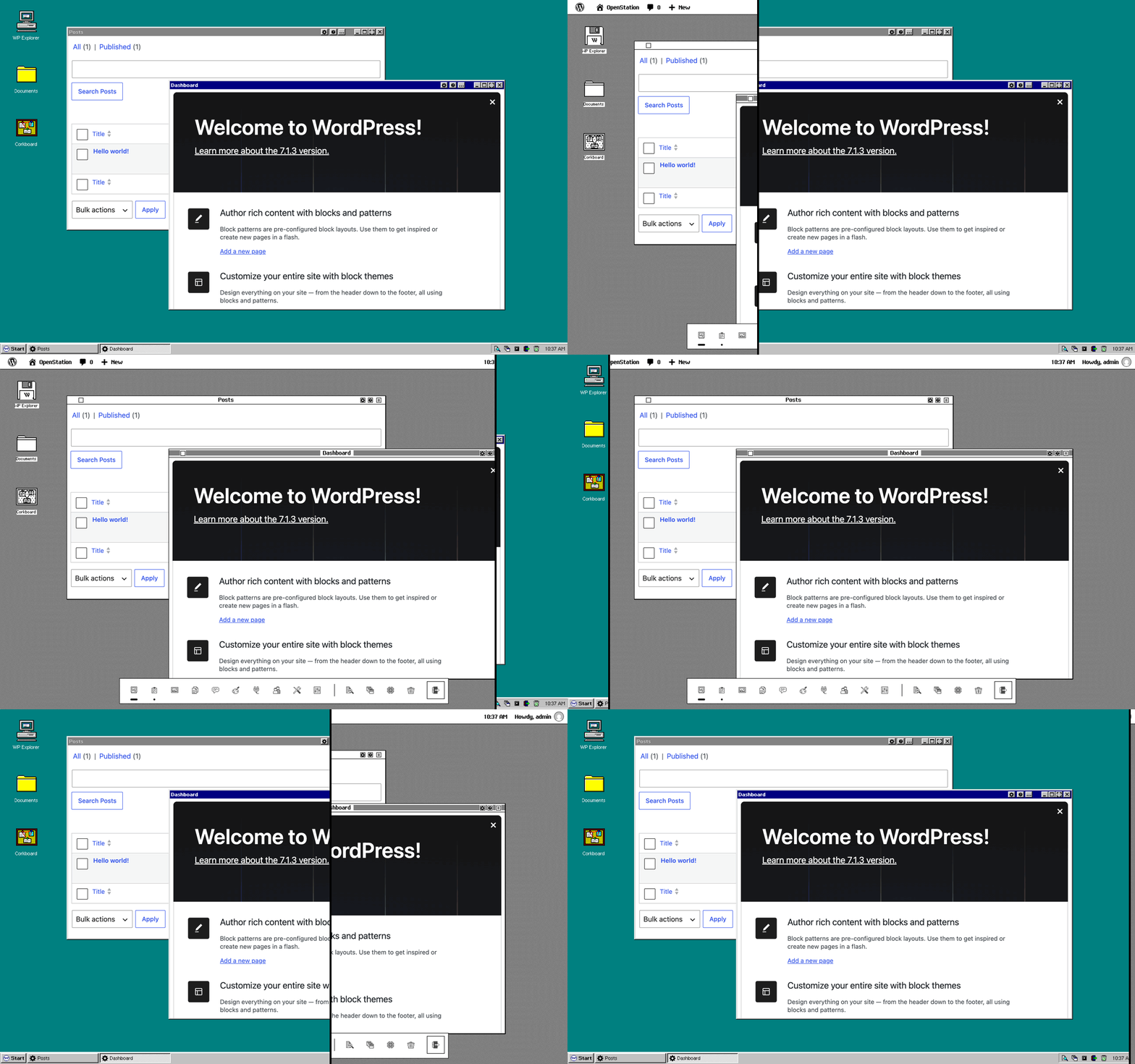
I’ve been wondering how far a theme can take OpenStation. Not just a wallpaper and a different color, but everything: windows, dock, menus, fonts, icons, layouts, etc. So I tried to make wp-admin look like two operating systems from a long time ago.
Can you believe that this is still WordPress? Turns out that the web is still fun! You only need WordPress, OpenStation, and one of these two themes.
Retro 95 reimagines wp-admin as Windows 95. It even comes with a Start menu! And the classic clock sitting in the bottom-right corner is also there. You can try it live.
Retro 84 is the counterpart for Apple fans. It turns wp-admin into the first graphical OS that many people ever saw: the original Macintosh’s System 1. The beloved monochrome display, the classic pixelated font, and more! Check out the live demo.
And here’s a fun fact: every icon is pixel art typed into a text file, one character per pixel. The fonts were also made the same way, letter by letter.
Underneath, it’s the same wp-admin as always, just a few decades older.
If you want to build your own theme, the docs list everything a theme can change. Maybe it’s time for a proper Windows Vista comeback.
In a fast-evolving tech industry, professionals are embracing diversification for stability and growth. This strategy fosters financial security, creativity, and adaptability, preparing individuals for unforeseen changes.