I have been using WordPress for a long time, and I still love it. But wp-admin has basically worked in the same way for years.
OpenStation is our attempt to change that.
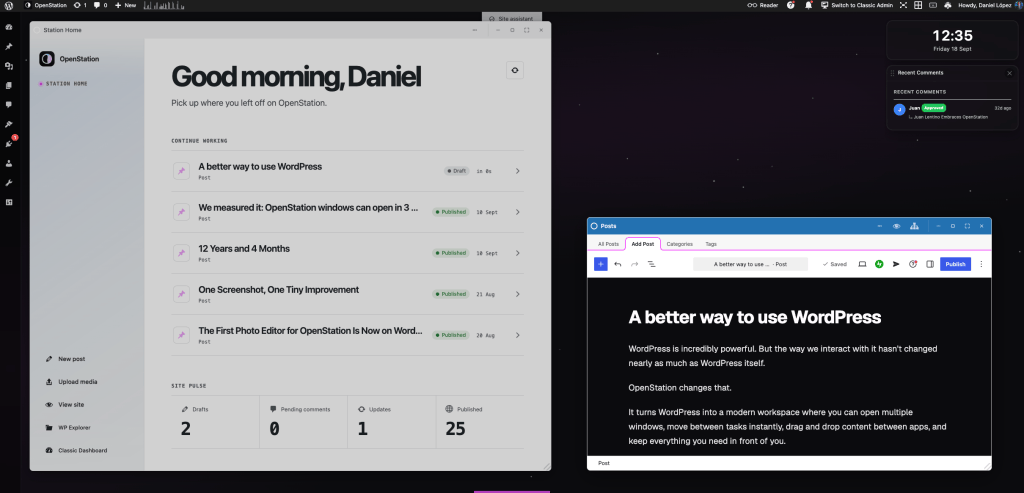
It’s a simple idea: instead of moving from one admin page to another, you have a desktop where you can open different parts of WordPress at the same time.
Your WordPress. Your workspace.
You can open your posts, pages, media, plugins, WooCommerce or any OpenStation app in different windows.
You can move them around, minimize them or put two things next to each other.
It may sound like a small difference, but once you start using WordPress this way, it changes a lot.
Real-time previews
You can also see your changes while you are working on them.
No need to constantly jump between wp-admin and the frontend just to check how something looks.
Apps inside WordPress
This is one of my favorite parts.
We are building apps like AllTerrain Forms, Photo Editor (And more!) specifically for OpenStation.
They are still WordPress plugins, but they feel much more like normal desktop apps.
WordPress on your phone
We also wanted OpenStation to work properly on mobile.
You can install it as a PWA and use WordPress from your phone almost like any other app.
Performance Is Fast. Really fast.
OpenStation is not only about changing how WordPress looks.
We have put a lot of work into making it fast. In many cases, opening and moving between WordPress screens is faster than using them directly from wp-admin.
We are also working on caching and preloading parts of WordPress before you need them.
The goal is very simple: you click something and it opens FAST.
And it is still WordPress
This is important.
We are not trying to replace WordPress or build another platform on top of it.
Your plugins are still your plugins. WooCommerce is still WooCommerce. Your content stays in WordPress.
OpenStation just gives you a different way to use all of it.
And, of course, it is open source.
Thank you
And finally, a big thank you to everyone in the WordPress community who has tried OpenStation, shared feedback, reported bugs or simply told others about it.
And especially to all the contributors who are helping us build it. OpenStation would not be what it is today without you.
There is still a lot we want to do, and seeing people contributing, experimenting and building things with OpenStation is probably the best part of the whole project.
This week Robert Jacobi shared about the evolving landscape of open source and tech. Highlights include AI’s growing role in security, WordPress and Apache fortifying their processes, LibreOffice redefining productivity with privacy, LoopConf rethinking event funding, and Switzerland’s bold move toward digital sovereignty. Explore how accountability, control, and sustainability are shaping the future of open technology.
Because this is a security release, it is recommended that you update your sites immediately.
You can download WordPress 7.1.1 from WordPress.org, or visit your WordPress Dashboard, click “Updates”, and then click “Update Now”. If you have sites that support automatic background updates, the update process will begin automatically.
WordPress 7.1.1 is a short-cycle release. The next major release will be version 7.2 and is currently planned for December.
The security team would like to thank the following people for responsibly reporting vulnerabilities, and allowing them to be fixed in this release:
Stored cross-site scripting in wpautop() allows an unauthenticated visitor to inject script (subject to comment approval), reported by Rafie Muhammad (Awesome Motive, Inc.).
HTML API: set_modifiable_text() allows breaking out of a comment via abrupt-closing sequences, reported by Jeremy Felt of the WordPress Security Team.
Stored XSS in some themes that support custom headers, reported by Jeremy Felt of the WordPress Security Team.
Specially crafted URLs can automatically install and preview an inactive theme from WordPress.org, reported by Paulos Yibelo and pwn.ai.
Site Administrator can network-activate an installed Network-only plugin, reported by Jesse McNeil.
Authenticated Path Traversal in WP REST Templates Controller, reported by Anthropic.
XML-RPC can be used to publish customize_changeset posts that bypass checks for edit_css, reported by Ben Bidner of the WordPress Security Team.
Contributor+ Arbitrary Post Overwrite, reported by Anthropic.
Missing read_post check in attachment_submitbox_metadata() leaks a private parent-post title, reported by HDWSec.
Missing Authorization leads to Draft/Pending Post Slug Disclosure by Contributor+, reported by hermanhms.
Comments, including notes, can be reparented by any authenticated user, reported by viridis.
WordPress 7.1.1 would not have been possible without the contributions of the following people. Their asynchronous coordination to deliver maintenance and security fixes into a stable release is a testament to the power and capability of the WordPress community.
As a courtesy, the security fixes are being backported, where necessary, to all branches eligible to receive security fixes (currently through 4.7). As a reminder, only the most recent version of WordPress is actively supported. The backports are in progress and will ship as they become ready.
How to contribute
To get involved in WordPress core development, head over to Trac, pick a ticket, and join the conversation in the #core channel. Need help? Check out the Core Contributor Handbook.
Every page load makes WordPress reread all autoloaded wp_options rows, even junk from deleted plugins. Check yours with one safe SQL query and clean it up.
When I first started thinking about how to mark the day, I knew I didn’t want a traditional memorial. Om loved bringing interesting people together, and he loved a festival that taught him something he didn’t already know. His curiosity crossed so many worlds and passions: technology, journalism, photography, investing, watches, pens, coffee, design, music, India, New York, San Francisco.
So we’re bringing these worlds together. On September 29 in San Francisco, we’re throwing OmFest—twelve hours of ideas, objects, food, music, and conversation, organized and anchored around a statement Om once said:
“If you pay enough attention to the present, you can see the future.”
Present Future
Instead of tributes or keynotes, we’ll host a series of short talks with one simple challenge: teach us something you’re seeing before everyone else sees it. No pitches, no career retrospectives. You don’t even have to talk about Om. What happens to photography when anyone can generate the perfect image with AI? Why do physical objects become more meaningful as our lives become more digital? Are glasses becoming computers? What does handwriting do to the way we think? Different subjects, same goal: everyone leaves knowing something they didn’t know when they arrived.
A Festival of Om’s Curiosity
Between the talks, there will be plenty to stumble upon. Through Om’s Lens: a gallery of Om’s photography. TIME: an exhibit that uses his watch obsession to spark a discussion about craft and collecting. Field Notes: a communal writing table stocked with fine paper, fountain pens, and ink, where you can write something worth remembering—and either keep it or leave it behind to be bound in a book to commemorate the day. And Om’s Shelf: books he read, loved, and recommended. The collection will start full and slowly empty as his favorite reads pass into other hands.
People from Om’s different worlds will drop in throughout the day to share knowledge and facilitate small, hands-on moments: a photography tutorial, a notebook-binding session, a lesson on the mechanics of a watch, an experience with a coffee you’ve never tried, a tea ceremony. And, woven into this experience, will be OM/60: sixty small discoveries about Om, hidden throughout.
All Roads Lead to Om
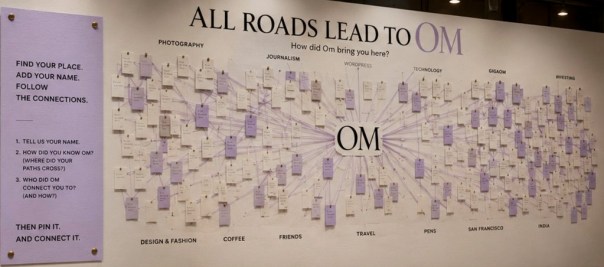
The most important part, however, isn’t any of these objects. At check-in, instead of a badge with your company and title, you’ll choose the worlds through which you knew Om: photography, journalism, technology, GigaOm, investing, WordPress, India, coffee, pens and ink, design, music, or simply friends and family.
Then we build a physical map of it. It starts nearly empty. You add yourself, mark how you knew Om and whom he introduced you to, and those people connect to others. By the end of the night, I hope we’ll be able to see what Om spent a lifetime making.
The question I keep asking myself: who will meet because of Om that Om never had the chance to introduce? If OmFest works, his network won’t just be documented that day. It’ll grow.
From Ideas to Celebration
The day flows and builds. Morning is coffee, breakfast, books, photography, and conversation. The middle is deliberately unstructured—wander, eat, write, talk. In the evening, friends share short stories as we raise a glass to Om on his 60th. Then the bars roll in, the lights go down, the music gets louder, and OmFest becomes DesiParty: his old-school New York nights, Asian Underground, bhangra, electronica. We start with ideas and end with dancing. That feels right.
Version 1.0
What we’re building shouldn’t end on September 29. What does registration look like if it’s designed to help strangers talk to each other? How do you design a conference around curiosity instead of status? How do you make something that works for a two-hour visit or a twelve-hour one? How does a room encourage connection without forcing networking?
We’re treating OmFest as an experiment. We’ll document what works—formats, designs, code, templates, check-in, programming—and open source as much of it as we can. Other events can take the best ideas and make them better.
September 29 isn’t the end of OmFest. It’s version 1.0.
Come Build with Us
People from across Om’s life are building OmFest together. Some are contributing photographs. Someone is making a textile; another is bringing tea and guiding ceremonies. Others are helping with watches, eyewear, books, music, writing, and stories. We haven’t discovered whole parts of Om’s world yet. That’s the point.